
Understanding the Foundation of the Human Body: Dr. Roy’s Engaging Lecture on Osteology
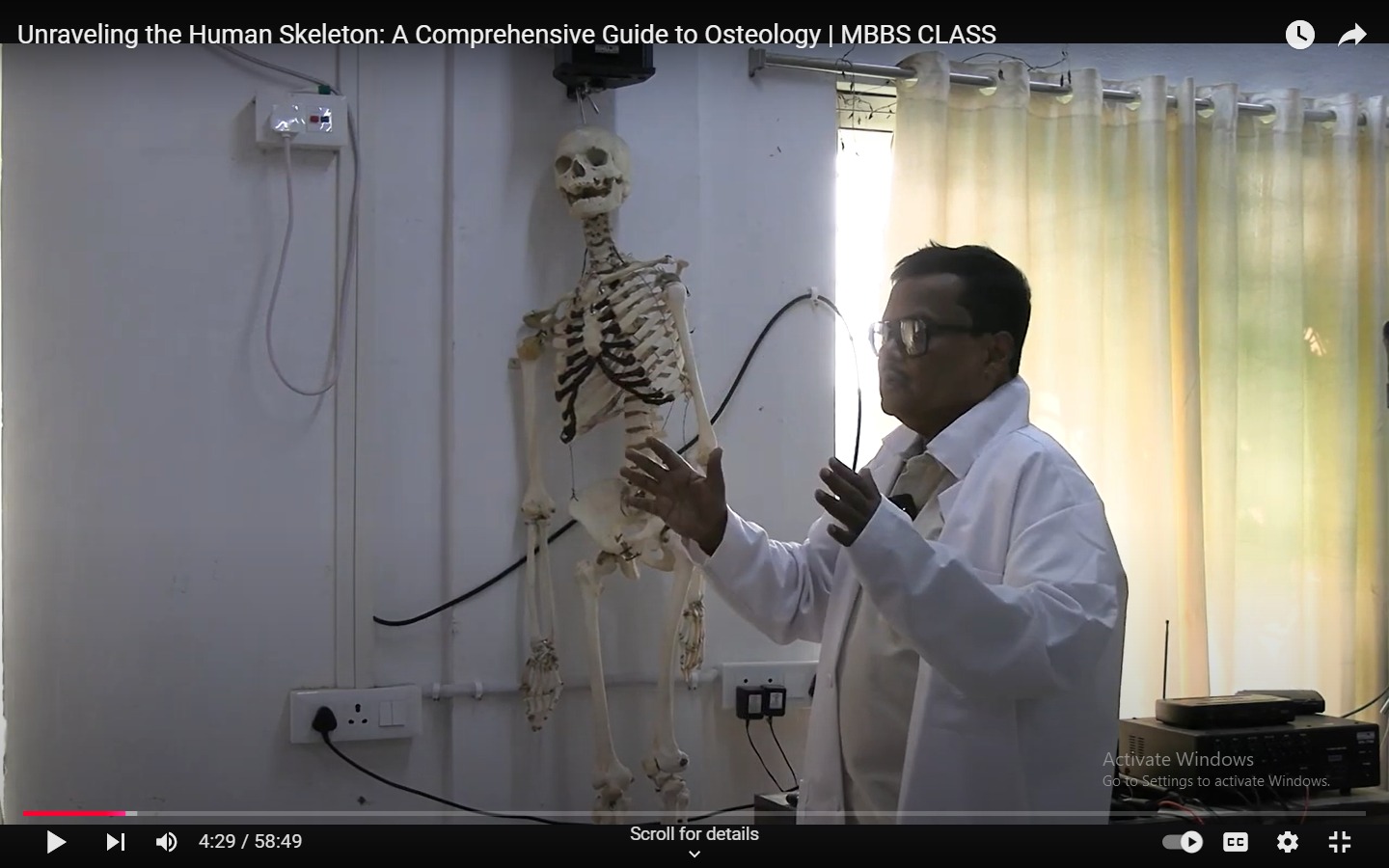
In a groundbreaking and interactive lecture at Santiniketan Medical College & Hospital, Dr. Abhijit Roy, a senior professor in Anatomy, took a group of eager medical students on an immersive journey through the intricate world of osteology. The lecture, titled “Unraveling the Human Skeleton: A Comprehensive Guide to Osteology,” combined theoretical insights with hands-on dissection demonstrations to offer a unique and comprehensive understanding of the human skeletal system.
Osteology, the study of bones and their structure, is fundamental to medical education, as the skeletal system forms the body’s framework, supports vital organs, and plays a crucial role in movement. Yet, for many students, understanding the complexities of human bones can be daunting. Dr. Roy’s approach was designed to simplify these complexities and make the subject not only accessible but also engaging.
The Significance of Osteology in Medical Education
Osteology is one of the foundational subjects in anatomy, but for many medical students, it is often perceived as a challenge due to the sheer volume of bones, joints, ligaments, and structures they need to learn. From the intricate details of the skull to the numerous small bones in the hands and feet, the subject demands precision and understanding of both structure and function. However, Dr. Roy believes that a hands-on, visual approach can make osteology a fascinating and manageable topic for medical students.
“Bones are the scaffolding of the body, providing structure, protection, and mobility. But understanding them goes beyond memorizing their names and locations. Osteology is about understanding how bones fit together and how they function to allow movement and protect vital organs,” said Dr. Roy at the beginning of his lecture.
Bringing Osteology to Life: A Real Classroom Demonstration
Dr. Roy’s lecture was not just a series of slides or textbook diagrams. He took a revolutionary approach to teaching osteology by conducting a live demonstration using real human skeletal remains. The demonstration involved carefully examining the various bones of the human body, highlighting their unique characteristics, and explaining their functional significance.
The first part of the lecture focused on the axial skeleton, including the skull, vertebral column, and rib cage. Students were given the opportunity to handle the bones and explore their structure. Dr. Roy pointed out the key anatomical features of the skull, explaining the differences between the frontal, parietal, and occipital bones, and how these structures protect the brain and sensory organs.
He then moved to the vertebral column, describing its essential role in supporting the body and protecting the spinal cord. The students were shown the five distinct regions of the spine — cervical, thoracic, lumbar, sacral, and coccygeal — and were taught how each region is specialized for different movements and levels of support.
“What you’re seeing here is not just a collection of bones,” Dr. Roy explained while holding up the vertebrae. “This is a complex system designed for movement, protection, and flexibility. The curvatures of the spine, for instance, allow us to stand upright, while at the same time providing shock absorption when we walk or run.”
Following the axial skeleton, Dr. Roy turned his focus to the appendicular skeleton, which includes the limbs and girdles. The hands-on demonstration provided students with a closer look at the structure of the arm, pelvis, and leg bones. He discussed the anatomy of the shoulder and hip joints, showing students how these ball-and-socket joints allow for a wide range of motion while maintaining stability.
Visual Learning Tools: Aiding in Osteological Understanding
While hands-on dissection and real skeletal models were integral to the lecture, Dr. Roy also utilized modern visual learning tools to enhance students’ comprehension of osteology. Using digital 3D anatomical software, students were able to rotate and zoom into different bones and joints, giving them a better understanding of their spatial relationships and movements.
“Just reading about bones or looking at 2D images often doesn’t do justice to the complexity of the skeletal system,” Dr. Roy stated. “Digital tools and 3D models allow students to interact with the anatomy in a way that is not possible with static pictures in textbooks. This visual learning experience is invaluable for understanding how bones and joints fit together.”
The digital tools also helped explain joint movements and how muscles interact with the skeletal system. Through animations, students were able to see how bones move during various activities, such as walking, running, and lifting. This dynamic approach helped them connect theory with real-world applications, giving them a deeper appreciation for how osteology plays a key role in daily life and clinical practice.
Osteology in Clinical Practice: Real-World Applications
Throughout the lecture, Dr. Roy emphasized the practical applications of osteology in clinical settings. He explained how knowledge of bones is critical not only for diagnosis and treatment but also for performing procedures such as joint replacements, fracture management, and spinal surgery.
“An understanding of the skeletal system is essential for a doctor, whether they are performing surgery or diagnosing a fracture,” said Dr. Roy. “You need to know the precise locations of bones, joints, and ligaments to avoid damaging structures that are essential for movement and health.”
He also provided clinical scenarios where students were encouraged to apply their anatomical knowledge. For instance, he asked them to consider the best way to approach a hip replacement surgery, guiding them through the anatomy of the pelvis and femur and explaining how to navigate important blood vessels and nerves during the procedure.
Moreover, Dr. Roy linked the importance of osteology to other fields of medicine, such as orthopedics, neurology, and sports medicine. He explained how understanding the biomechanics of bones can help doctors diagnose conditions such as arthritis, scoliosis, and bone fractures.
Encouraging Active Learning: Student Engagement
Dr. Roy’s teaching style is characterized by a commitment to active learning, where students are not mere spectators but are encouraged to actively participate in the learning process. Throughout the lecture, students were invited to handle skeletal models, ask questions, and engage in discussions about bone structure and function.
“We learn best when we are actively involved in the process,” Dr. Roy remarked. “When students handle bones and explore their structure, they not only improve their understanding of anatomy but also develop a deeper appreciation for how the human body works.”
He also incorporated group activities, where students worked together to identify bones and joints on anatomical models. This collaborative approach helped reinforce their knowledge and fostered teamwork, an essential skill in medical practice.
The Role of Repetition in Mastering Osteology
Dr. Roy emphasized that mastering osteology requires regular practice and repetition. “You cannot learn the bones and joints by reading them once. It takes time and repetition,” he said. He encouraged students to revisit the bones regularly, test their knowledge, and engage in group discussions to reinforce their understanding.
To aid this process, Dr. Roy recommended that students use anatomical flashcards, 3D apps, and other interactive learning tools that would allow them to repeatedly engage with the material and test their recall.
“Repetition, especially with hands-on learning, is key to making this knowledge stick. The more you engage with the material, the easier it becomes to recall it when you need it during clinical practice or exams,” Dr. Roy added.
Conclusion: Bringing Osteology to Life
Dr. Abhijit Roy’s lecture on osteology at Santiniketan Medical College & Hospital was a resounding success, offering students a comprehensive and engaging look at the human skeleton. By combining traditional dissection with modern visual learning tools, real-world applications, and active student involvement, Dr. Roy provided a holistic learning experience that went beyond simple memorization of bones.
The students walked away not only with a deeper understanding of osteology but with a renewed sense of excitement and curiosity about the human body. By making osteology accessible, interactive, and relevant to clinical practice, Dr. Roy has set a new standard for teaching anatomy at Santiniketan Medical College.
As medical education continues to evolve, Dr. Roy’s innovative approach is a shining example of how integrating traditional methods with modern technology can create a richer, more dynamic learning experience. For the students at Santiniketan, the journey into osteology has just begun, but with the tools and techniques introduced in this lecture, they are well-equipped to navigate the complex world of the human skeleton with confidence.