

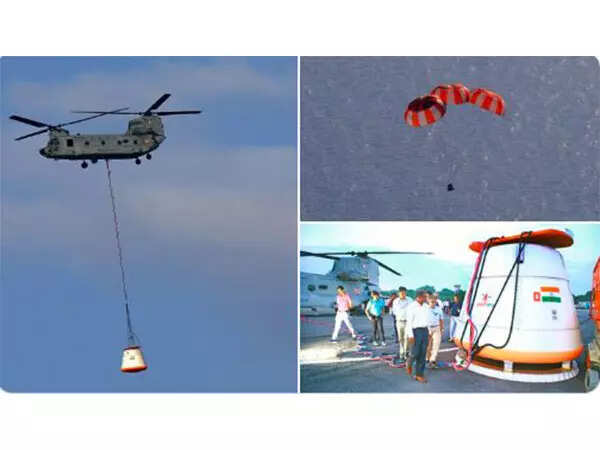
India’s space journey has taken yet another significant leap forward. The Indian Space Research Organisation (ISRO) has successfully completed the first Integrated Air Drop Test (IADT-01) for the nation’s ambitious Gaganyaan Mission — the program that aims to send Indian astronauts, or “Vyomnauts,” into space aboard an indigenously developed spacecraft.
This landmark achievement is not merely a technical experiment, but also a giant step toward establishing India among the select group of nations capable of independently conducting human spaceflight missions.
The Test: A Detailed Account
The trial was conducted at the Satish Dhawan Space Centre in Sriharikota, Andhra Pradesh. During the test, a heavy-lift Chinook helicopter carried a 4.8-ton crew module to an altitude of nearly 3 kilometers before releasing it mid-air.
To ensure a safe descent, 10 parachutes were deployed in a carefully orchestrated sequence. The module gradually slowed down and landed safely, proving that the designed system could effectively manage the return journey of astronauts from orbit to Earth.
The entire operation was executed with precision, demonstrating ISRO’s growing mastery over complex re-entry and landing technologies.
Purpose of the Experiment
The main goal of the IADT-01 was to validate the crew module’s safe landing capability. Specifically, scientists wanted to test:
- Whether the module carrying astronauts can re-enter Earth’s atmosphere and land without damage.
- The effectiveness of parachute deployment systems in reducing descent velocity.
- The reliability of safety mechanisms to protect astronauts during re-entry and landing.
ISRO scientists later confirmed that the test produced encouraging results, laying a strong foundation for the upcoming stages of the mission.
ISRO’s Legacy of Success
The achievement adds another feather to ISRO’s illustrious cap. Over the past decades, India’s space agency has made global headlines for a series of pathbreaking accomplishments:
- Chandrayaan-3 became the first mission in history to land successfully on the Moon’s south pole.
- Mangalyaan (Mars Orbiter Mission) established India as the first Asian country to reach Martian orbit, and the fourth in the world overall.
- The cost-effective yet reliable PSLV and GSLV rocket programs have made India a leading satellite launch hub for countries worldwide.
Gaganyaan, however, takes India’s space program into a new domain — human spaceflight, a technological frontier mastered by only a handful of nations.
Gaganyaan: India’s Human Spaceflight Dream
The Gaganyaan Mission aims to send a crew of Indian astronauts into space for a mission lasting a few days, marking India’s entry into the elite human spaceflight club. If successful, India will become only the fourth country in the world — after Russia, the United States, and China — to achieve this feat using its own technology.
The crew members, popularly referred to as “Vyomnauts” (derived from the Sanskrit word “Vyom” meaning space), will represent India’s aspirations and determination in the field of space exploration.
The Road Ahead
ISRO has clarified that this air drop test is just one among several crucial experiments planned for the mission. Upcoming tests will include:
- Crew Escape System Test: Ensuring astronauts can safely evacuate in case of emergencies.
- High-altitude re-entry trials: Simulating real mission scenarios.
- Long-duration simulations: Validating the durability and reliability of life-support systems inside the spacecraft.
Only after completing these rigorous steps will ISRO move ahead with the final launch that will carry astronauts into space.
National Pride and Global Significance
The success of the Gaganyaan Mission will mark not just a technological milestone but also a chapter of immense national pride. It will underline India’s emergence as a self-reliant technological powerhouse capable of competing with the world’s most advanced nations.
Beyond prestige, the mission also has far-reaching implications:
- It will inspire India’s youth to pursue careers in science, engineering, and space research.
- It will open doors for deeper collaborations in global space exploration projects.
- It will establish India as a leader in cost-effective human spaceflight solutions.
Expert Reactions
Commenting on the success, ISRO scientists highlighted the significance of the IADT-01:
“This test validates one of the most critical aspects of human spaceflight — safe return to Earth. Each successful experiment builds confidence and brings us closer to realizing the dream of sending Indians into space on Indian rockets.”
Conclusion
The successful completion of the Integrated Air Drop Test (IADT-01) is a landmark in India’s march toward its first human spaceflight. It demonstrates ISRO’s scientific precision, relentless determination, and the nation’s collective dream of conquering new frontiers in space.
When the day arrives that Indian astronauts soar into orbit aboard Gaganyaan, it will be more than just a space mission — it will be a symbol of India’s rise as a global space power. The historic journey has already begun, and the dream is closer than ever.
As future generations look back, they will proudly say:
“Yes, India too has sent humans into space — with its own technology, and with unmatched determination.” 🇮🇳