

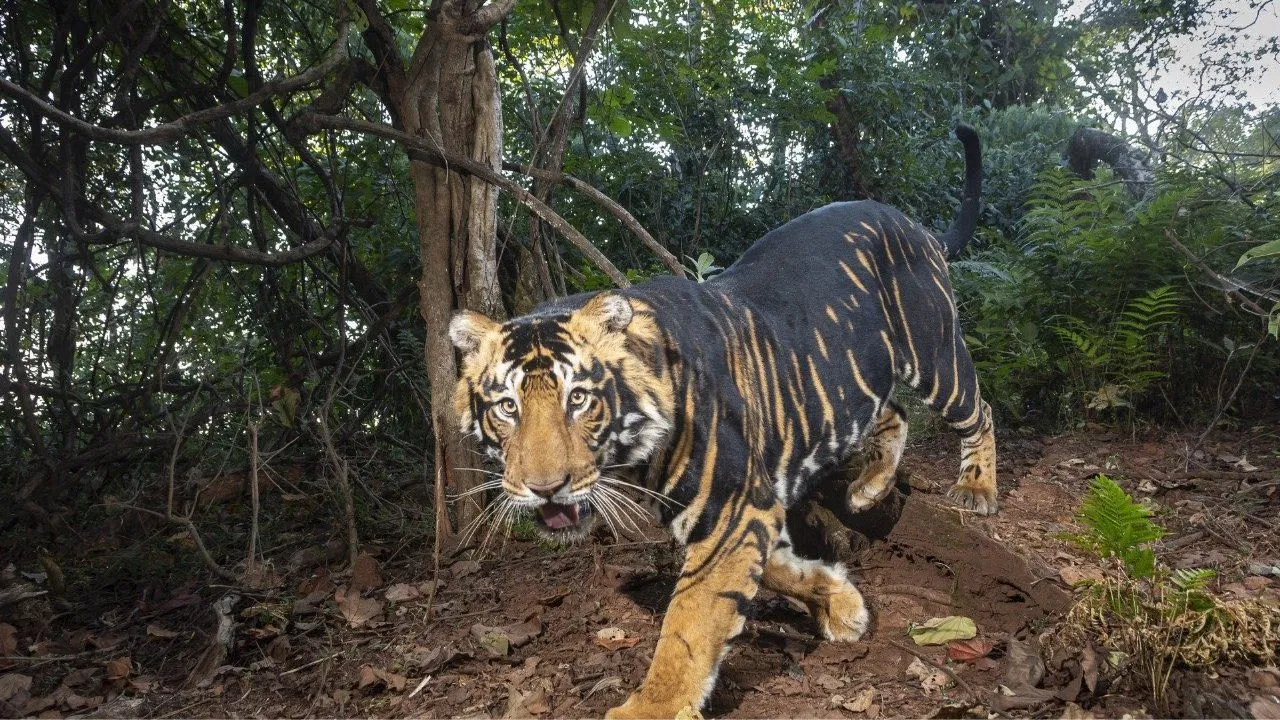
India’s Pride: India has long been celebrated across the world for its extraordinary natural diversity, vast forest landscapes, and rich wildlife heritage. From snow-covered mountain ranges to dense tropical rainforests, the country shelters countless species that contribute to the global ecological balance. Among these natural treasures, one mysterious and exceptionally rare phenomenon has captured international attention — the presence of the black tiger, found only in the Similipal Tiger Reserve of Odisha. This remarkable discovery is not just a visual marvel of nature but also a powerful symbol of India’s commitment to wildlife conservation.
The Black Tiger: More Than a Color Variant
The term “black tiger” often creates the impression of a tiger with a completely black coat. In reality, the black tiger is not entirely black. Scientists explain that this rare appearance is the result of a genetic condition known as melanism. Due to this condition, the dark stripes on the tiger’s body become unusually thick and dense, almost covering the traditional orange background. As a result, the tiger appears black from a distance, creating an illusion that sets it apart from typical Bengal tigers.
This form is scientifically described as a pseudo-melanistic tiger. It is not a separate species but a unique genetic expression within the Bengal tiger population. What makes it extraordinary is its extreme rarity and its confinement to a single geographical region, making it one of the rarest tiger variations on Earth.
Similipal Tiger Reserve: The Only Known Habitat
Located in the Mayurbhanj district of Odisha, Similipal Tiger Reserve is one of India’s most biologically rich forest regions. Spanning nearly 2,750 square kilometers, the reserve is home to thick sal forests, rolling hills, flowing rivers, and scenic waterfalls. This diverse ecosystem supports a wide range of wildlife, including elephants, leopards, deer, reptiles, and hundreds of bird species.
Experts believe that Similipal’s unique environmental conditions have played a crucial role in the survival of the black tiger. The region’s relative geographical isolation and limited tiger population have allowed certain genetic traits to persist across generations. This natural isolation has acted as a biological shelter, protecting rare characteristics that might otherwise disappear in more open habitats.
Discovery Through Technology: Camera Traps Reveal the Secret
The existence of black tigers in Similipal was first confirmed through camera trap technology used by forest authorities. These motion-activated cameras captured rare images of the dark-striped tigers roaming freely in the wild. The photographs quickly drew global attention, sparking excitement among wildlife researchers, conservationists, and nature enthusiasts.
What made this discovery particularly important was that it provided scientific evidence rather than anecdotal reports. It marked a new chapter in India’s wildlife documentation and highlighted the importance of technology in conservation monitoring.
Scientific Research and Genetic Insights
Following the discovery, extensive research was initiated to understand the genetic background of black tigers. Studies revealed that the unusual appearance is linked to a mutation affecting the distribution of pigmentation in the tiger’s fur. This mutation increases the concentration of melanin, leading to broader and darker stripes.
Scientists also observed that the relatively closed breeding population within Similipal contributed to the stability of this genetic trait. Limited migration of tigers into and out of the reserve resulted in repeated inheritance of the same genes, allowing the black pattern to remain visible across generations.
These findings have helped researchers gain deeper insight into tiger genetics and evolutionary adaptation, providing valuable data for future conservation strategies.
A Symbol of India’s Conservation Success
The presence of black tigers stands as a powerful indicator of India’s conservation achievements. Over the decades, the country has implemented multiple programs to protect its national animal and restore shrinking habitats.
One of the most significant initiatives is Project Tiger, launched in 1973. This program transformed wildlife management across India by establishing protected reserves, strengthening forest patrols, and creating scientific monitoring systems. Alongside this, stricter forest protection laws, improved surveillance technology, and community-based conservation models have contributed to stabilizing tiger populations.
The survival of such a rare genetic variation would not have been possible without consistent protection of forest ecosystems. Similipal’s black tiger population reflects the long-term impact of these efforts.
Global Significance of Similipal’s Black Tigers
Since black tigers have not been documented in any other part of the world, Similipal has gained international scientific importance. Researchers from various countries have expressed interest in studying this rare phenomenon. The reserve is now considered a valuable natural laboratory for understanding genetic diversity in large carnivores.
This global recognition has enhanced India’s reputation as a leader in wildlife conservation. It demonstrates that sustainable environmental policies and scientific approaches can preserve even the most fragile biological traits.
Tourism Potential and Responsible Development
The growing fame of black tigers has also increased interest in eco-tourism around Similipal. Wildlife photographers, researchers, and nature lovers are drawn to the reserve in hopes of witnessing this rare marvel.
However, conservation experts emphasize that tourism must be carefully managed. Uncontrolled human activity can disturb sensitive habitats and threaten wildlife behavior. Sustainable tourism practices, limited visitor access, and strict environmental regulations are essential to ensure that economic benefits do not come at the cost of ecological damage.
When managed responsibly, eco-tourism can support local livelihoods while raising awareness about wildlife protection.
Role of Local Communities in Conservation
The success of Similipal’s conservation efforts is closely linked to the participation of local communities living near the forest boundaries. Indigenous and rural populations have traditionally depended on forest resources for survival. Recognizing this, conservation programs have focused on balancing livelihood needs with environmental protection.
Through education programs, alternative income opportunities, and employment as forest guards and eco-tourism guides, local residents have become active partners in conservation. Their involvement has significantly reduced human-wildlife conflict and illegal activities, strengthening long-term protection efforts.
Challenges Ahead: Protecting a Fragile Future
Despite the success story of black tigers, several challenges remain. Climate change, deforestation, illegal wildlife trade, and expanding human settlements pose ongoing threats to forest ecosystems.
Changes in rainfall patterns and temperature can affect prey availability and habitat conditions. Additionally, the genetic uniqueness of Similipal’s tiger population requires careful management to avoid inbreeding risks.
Experts stress the need for continuous monitoring, habitat restoration, and regional connectivity between forest corridors to maintain healthy tiger populations while preserving rare genetic traits.
The Black Tiger as a National Symbol
Beyond scientific and ecological value, the black tiger represents a deeper cultural and environmental message. It reminds society of the beauty hidden within protected forests and the importance of coexistence between humans and nature.
This rare animal symbolizes resilience, adaptation, and the rewards of long-term conservation commitment. It also highlights how protecting biodiversity is not just about saving individual species but about preserving entire ecosystems that support life on Earth.
Conclusion: A Rare Treasure Worth Protecting
The black tiger of Similipal is more than a biological curiosity — it is a global natural treasure and a source of national pride for India. Its survival reflects decades of conservation efforts, scientific dedication, and community participation.
As the world faces increasing environmental challenges, Similipal’s black tiger stands as a reminder that nature can still thrive when given protection and respect. Safeguarding this rare marvel is not only India’s responsibility but a shared duty toward global biodiversity.
By preserving the forests of Similipal and strengthening conservation initiatives, India continues to set an example for sustainable wildlife protection. The black tiger remains a silent ambassador of nature’s wonder — a symbol of hope, balance, and the extraordinary power of conservation.
Read More: The Rose Elixir: Why Gulkand is the Ultimate Secret to Radiant Skin