For decades, we have viewed Mars as a dusty, desolate wasteland—a “Red Planet” defined by its bone-dry craters and freezing winds. However, recent data sent back by NASA’s Perseverance Rover from the Jezero Crater is challenging everything we thought we knew.
The discovery of a specific mineral, initially overlooked but now the center of scientific fascination, suggests that Mars wasn’t just “damp”—it may have experienced millions of years of persistent rainfall.
The Discovery of Kaolinite: A Game Changer
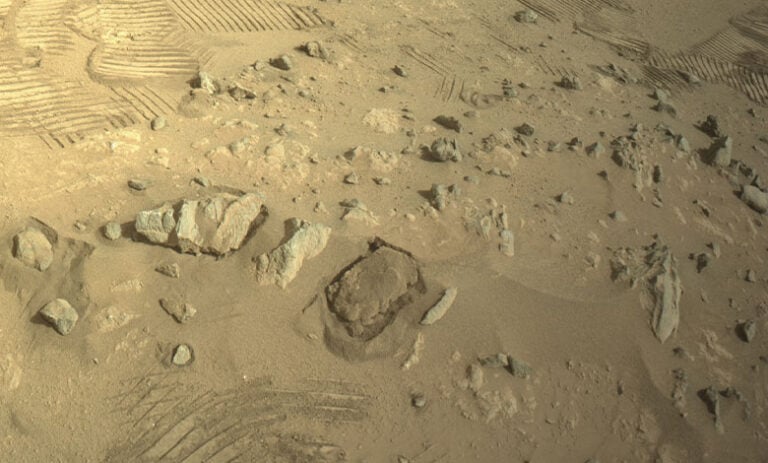
While scanning the rugged terrain of the Jezero Crater, Perseverance captured images and data of a rock that appeared ordinary at first glance. Upon closer inspection and chemical analysis, scientists identified the presence of Kaolinite.
On Earth, Kaolinite is a clay mineral that doesn’t just “appear.” It is formed through a very specific geological process:
Intense Weathering: It requires the presence of liquid water.
Sustained Heat: High temperatures accelerate the chemical breakdown of parent rocks.
The Rainfall Factor: Most importantly, Kaolinite is typically the product of millions of years of rainfall washing over the landscape.
From “Dry Desert” to “Tropical Past”
Scientists have long known that Mars once had rivers, lakes, and perhaps even oceans. However, the timeline and nature of that water have always been a subject of debate. Was the water trapped under ice? Did it flow only briefly after volcanic eruptions?
The presence of Kaolinite suggests a much more “Earth-like” climate than previously imagined. For this mineral to form in the quantities detected:
Mars must have had a thick atmosphere capable of supporting a water cycle.
The planet likely experienced consistent precipitation (rain) over vast geological timescales—not just days or weeks, but millions of years.
The climate would have been significantly warmer than the sub-zero temperatures we see today.
“Finding Kaolinite is like finding a fingerprint of a tropical rainforest’s foundation on a planet we thought was a frozen desert,” notes one researcher.
Why It Matters for the Search for Life
This discovery shifts the narrative of Martian exploration. If Mars experienced millions of years of rainfall, it means the planet had a stable, long-term habitable environment. On Earth, areas rich in Kaolinite are often teeming with microbial life. By studying these “rain-fed” stones, NASA scientists hope to find organic molecules or biosignatures that may have been preserved within the clay layers for billions of years.
The Road Ahead
As the Perseverance Rover continues its journey toward the rim of the Jezero Crater, the focus has shifted. Every stone is now a potential witness to a lost era of Martian storms and humid heat.
The mystery remains: How did a planet with such a lush, rainy past turn into a dry, red husk? Solving this puzzle won’t just tell us about Mars; it will help us understand the atmospheric evolution of all rocky planets—including our own.