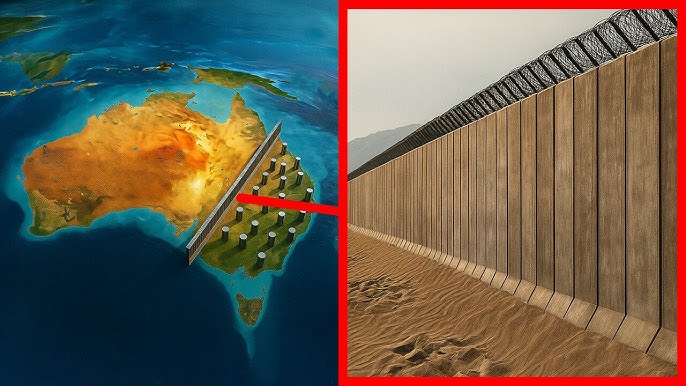
When most people think of iconic human-made barriers, the Great Wall of China inevitably comes to mind. Yet, buried deep within the vast landscapes of Australia lies another astonishing marvel—not built of stone, but of simple wire, posts, and relentless human determination. Known as the Dingo Fence, this sprawling barrier holds the record as the longest fence in the world. Stretching close to 5,614 kilometers—nearly the distance from New Delhi to London—the fence represents not only a country’s attempt to defend an industry, but also the never-ending tussle between mankind and nature.
🐑 A Century Ago: Sheep, Wool, and an Unwanted Predator
In the 19th century, Australia stood at the heart of global wool production. At one point, the phrase “Australia rode on the sheep’s back” was used to describe the economy’s heavy reliance on the wool industry. Millions of sheep grazed across farmlands from Queensland to New South Wales, supplying the world’s textile demand.
But prosperity had a predator: the dingo, Australia’s wild dog.
Dingoes, smart and relentless hunters, would raid sheep flocks by night. Records suggest that in just one evening, dingoes could wipe out hundreds of sheep—not always for food, often simply as surplus hunting behavior. This devastating loss of livestock threatened farmers’ livelihoods and, by extension, the national economy.
Faced with recurring attacks, Australian pastoralists decided that if the enemy could not be eradicated, it must be kept out. Thus began one of the most ambitious human undertakings of the 19th century: building a fence not around a home or a farm, but across entire regions of the continent.
🛠️ Building the Dingo Fence: An Engineering Feat
What began as local attempts by farmers to protect their flocks soon evolved into a massive coordinated project spanning multiple states. By the 1880s, extensive government-backed construction began.
The Dingo Fence was pieced together from multiple state-run barrier projects. Wooden posts, barbed wire, mesh, and later reinforced steel became its components. Its path runs from the dry, open expanses of western Queensland, through the deserts of South Australia, and into the grasslands of New South Wales.
Standing only a few meters tall, the fence itself is not majestic in appearance. But its true grandeur is in scale. At 5,614 kilometers, this barrier is longer than the Great Wall of China if measured in a straight line. From satellites, it carves an artificial scar across the Australian Outback—visible proof of mankind’s attempt to redraw nature’s map.
🌾 The Purpose: Protecting the Industry That Fed a Nation
The fence’s primary aim was straightforward: separate dingoes from sheep.
By cordoning off the southeastern grazing lands—the heartland of Australia’s wool industry—from the arid zones to the north and west where dingoes thrived, farmers ensured their livestock survived. At its peak, the fence gave pastoralists economic stability, enabling Australia to remain one of the largest wool exporters worldwide for decades.
For rural families whose entire lives depended on sheep farming, the fence represented a lifeline. Without it, many argue, modern Australia’s formative economic story would have been very different.
💸 The Cost of Maintenance
Yet, building the fence was only half the battle. Maintaining it has been an endless, costly undertaking.
-
Annual Budget: Today, tens of millions of dollars are spent each year repairing, monitoring, and upgrading the fence.
-
Threats: Cyclones, sandstorms, floods, and widespread bushfires regularly damage sections. Wild animals—from kangaroos to emus—can also bring parts down.
-
Human Labor: Teams of “fence inspectors” live in isolation along its length, traveling hundreds of kilometers to check for breaches and ensure it remains intact.
In a land where distances are daunting and weather is unforgiving, keeping a wire fence functional across deserts and plains is nothing short of a logistical feat.
🐕 An Ecological Controversy
Despite its success as a livestock shield, the Dingo Fence has been the subject of heated debate among scientists, environmentalists, and policymakers.
Why? Because dingoes are not just pests—they are apex predators.
-
Dingoes regulate populations of kangaroos, wallabies, and smaller invasive predators such as feral cats and foxes.
-
Where dingoes have been excluded, ecosystems have shown signs of imbalance. Overgrazing by booming kangaroo populations has degraded pastures. Meanwhile, unchecked foxes and cats prey heavily on small marsupials, driving some species closer to extinction.
-
This has sparked a broader question: by protecting sheep, did Australians damage their broader ecological heritage?
Environmentalists argue that dingoes should be recognized as a keystone species essential to Australia’s biodiversity. The fence, in their view, is an artificial intervention with long-term costs to the natural system.
🚜 Farmers’ Voice: The Fence as a Savior
For farmers, however, the fence is non-negotiable. They see it as the guardian of their livelihoods.
Generations of pastoralists recall stories of entire herds lost in single nights before the barrier existed. Without protection, sheep farming—especially in the southeast—would collapse against relentless predation.
“The fence is more than steel and wire,” many say. “It is our survival.”
This clash—between environmental concern and agricultural necessity—continues to fuel debates in government halls and rural pubs alike.
🌏 A Place in the Record Books
The Dingo Fence today stands not only as a livestock defense but also as a world record holder:
-
World’s Longest Fence: At nearly 3,500 miles, it dwarfs other famous barriers, including parts of the U.S.-Mexico border wall.
-
A Global Curiosity: Historians and travelers sometimes refer to it as “Australia’s Great Wall”—though unlike China’s monument to military defense, this one marks humankind’s battle to defend sheep.
-
A Symbol: It is simultaneously a feat of engineering, an agricultural artifact, and an ecological dilemma.
🔮 Looking Ahead: The Future of the Fence
In the 21st century, Australia no longer leans as heavily on wool as it once did. The economy has diversified into minerals, energy, technology, and services. As a result, questions loom:
-
Should such immense funds still be poured into maintaining the Dingo Fence?
-
Or should the nation allow parts of it to disappear, letting dingoes naturally reclaim their lost ranges?
-
Could there be a middle path—scientifically managed coexistence, combining predator control with ecosystem preservation?
Some scientists advocate scaling the fence back gradually, allowing experiments in selective coexistence. Others believe it should be preserved, not just as a barrier but as a cultural landmark, much like the Great Wall of China: a testament to human resolve.
✍️ The Dingo Fence: Humanity’s Symbolic Battle
The Dingo Fence is more than wire stretched across the Outback. It is a narrative in metal and wood—a story of survival, ingenuity, and unintended consequences.
Like China’s Great Wall, it was born from fear and necessity. But while one defended against foreign armies, this one rose to keep out a native predator.
Today, it continues to spark conversations about how far humans should go in altering nature to fulfill their needs. Whether praised as a lifeline or criticized as ecological folly, it remains an extraordinary landmark—sometimes invisible in its simplicity, yet monumental in meaning.
As long as it stands, the Dingo Fence will remain the world’s longest reminder of mankind’s fragile balancing act with nature.