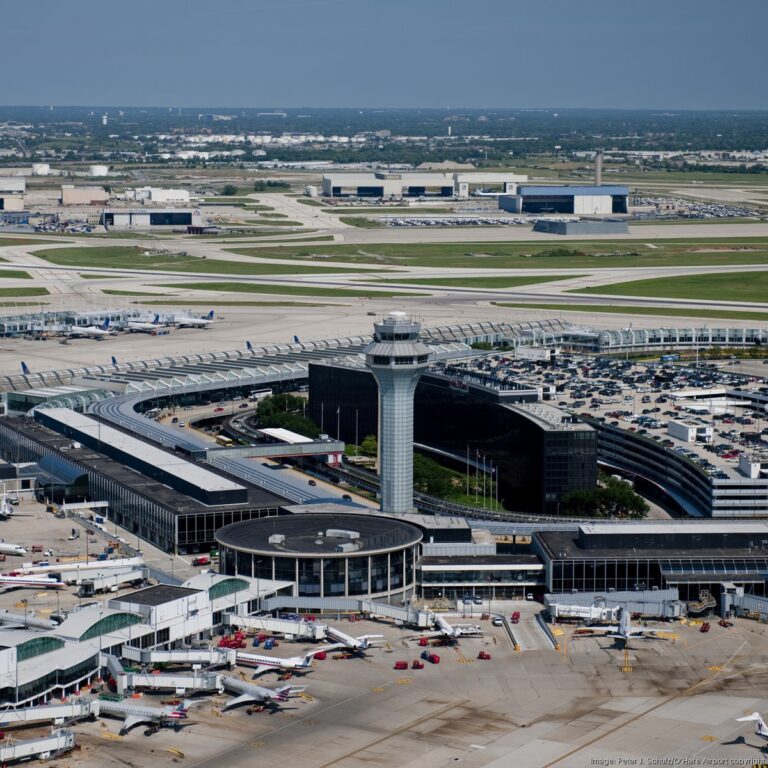
Chicago O’Hare International Airport: Located approximately 27 kilometers northwest of downtown Chicago, O’Hare International Airport (ORD) is far more than a transportation hub—it is a cornerstone of global aviation history and one of the most influential airports in the world. For decades, O’Hare has stood as a symbol of scale, efficiency, and connectivity, earning its reputation as one of the busiest airports on the planet.
Serving as a vital gateway between North America and the rest of the world, O’Hare handles an immense volume of domestic and international traffic every day. Its strategic location in the heart of the United States, combined with cutting-edge infrastructure, advanced air traffic systems, and its role as a primary hub for major airlines, has made it a critical engine of global mobility.
Even as newer mega-airports emerge worldwide, Chicago O’Hare continues to redefine relevance—balancing historical legacy with ambitious modernization plans that aim to secure its leadership well into the future.
1. Origins and Naming: From Wartime Utility to Global Gateway
The story of O’Hare International Airport begins during the turbulent years of World War II. Originally known as Orchard Place Airport, the site was developed as a manufacturing and testing center for military aircraft. During the war, it played a key role in supporting the United States’ aviation and defense efforts, symbolizing industrial strength and strategic foresight.
Following the war, as commercial aviation expanded rapidly, the airport was repurposed for civilian use. In 1949, it was officially renamed O’Hare International Airport in honor of Lieutenant Commander Edward “Butch” O’Hare, a celebrated U.S. Navy fighter pilot.
Edward O’Hare was one of the first naval aviators to receive the Medal of Honor during World War II. His extraordinary bravery and aerial combat achievements made him a national hero. Naming the airport after him was both a tribute and a reminder of the courage and innovation that shaped modern aviation.
From these wartime roots, O’Hare evolved into a central pillar of international air travel.
2. Massive Infrastructure and Runway Excellence
One of O’Hare’s defining strengths is its extraordinary infrastructure scale. The airport is among a small group worldwide that operate with eight or more runways, enabling it to manage simultaneous takeoffs and landings with remarkable efficiency.
This expansive runway system significantly reduces congestion and allows the airport to handle a high volume of aircraft movements—even during peak travel periods. O’Hare’s layout has been carefully engineered to support rapid aircraft turnaround times while maintaining safety and precision.
Given Chicago’s harsh winters, O’Hare is also renowned for its advanced cold-weather operations. Sophisticated snow-removal fleets, de-icing technologies, and real-time weather monitoring systems allow the airport to remain operational during snowstorms and extreme cold—conditions that would cripple many other airports.
Key infrastructure features include:
- Multiple domestic and international terminals
- Hundreds of boarding gates
- Advanced baggage-handling and tracking systems
- High-speed taxiways and apron areas
- Dedicated cargo and logistics facilities
Each day, thousands of flight operations are conducted with remarkable coordination, making O’Hare one of the most operationally complex airports in the world.
3. A Historic Leader Among the World’s Busiest Airports
For much of the latter half of the 20th century, O’Hare was widely recognized as the busiest airport on Earth. From the 1960s through the 1990s, it consistently ranked at the top in terms of aircraft movements—a testament to its unmatched capacity and strategic importance.
Several factors contributed to this dominance:
- Its central geographic position within the United States
- Balanced integration of domestic and international routes
- High-frequency short-haul and long-haul connections
- Strong airline hub operations
Although some airports have since surpassed O’Hare in total passenger numbers, it remains one of the world’s busiest by aircraft movements, a metric that reflects the airport’s intense operational tempo.
Even today, O’Hare consistently ranks among the top global airports for overall activity, reinforcing its enduring relevance in the aviation ecosystem.
4. A Crucial Airline Hub Powering Global Connectivity
O’Hare International Airport serves as a primary hub for United Airlines and American Airlines, two of the largest carriers in the world. This dual-hub status dramatically amplifies the airport’s importance.
Every day, tens of thousands of passengers pass through O’Hare on connecting flights, using it as a bridge between cities, continents, and cultures. The hub-and-spoke system allows travelers to reach hundreds of destinations efficiently, often with minimal connection times.
From O’Hare, passengers can access:
- Major U.S. cities coast to coast
- Key European capitals
- Strategic Asian and Middle Eastern hubs
- Emerging markets across the Americas
This connectivity makes O’Hare indispensable not only to airlines but also to global business, diplomacy, tourism, and migration.
5. Technology, Innovation, and Sustainability
To manage its enormous traffic volume, O’Hare has consistently invested in technological innovation. The airport utilizes state-of-the-art Air Traffic Control (ATC) systems that integrate satellite navigation, digital radar, and predictive analytics.
One of the most significant advancements has been the adoption of NextGen air traffic technologies, which enhance precision, reduce delays, and improve fuel efficiency. These systems enable aircraft to follow optimized flight paths, lowering emissions and operating costs.
Environmental sustainability is also a growing priority. O’Hare has implemented:
- Energy-efficient terminal designs
- Increased use of renewable and cleaner energy sources
- Waste-reduction and recycling programs
- Eco-friendly ground transportation initiatives
Enhanced security technologies, including advanced screening systems and biometric solutions, further ensure passenger safety while maintaining smooth passenger flow.
6. Economic Impact: A Catalyst for Growth
The economic influence of O’Hare International Airport extends far beyond aviation. It is one of the largest economic engines in the Midwestern United States.
Through its operations, O’Hare:
- Facilitates the movement of millions of passengers annually
- Handles vast volumes of air cargo and freight
- Supports tens of thousands of direct and indirect jobs
- Strengthens international trade and logistics
Industries such as tourism, manufacturing, technology, and finance all benefit from O’Hare’s global reach. For Chicago, the airport is not just infrastructure—it is a strategic asset that drives regional and national prosperity.
7. Passenger Experience and World-Class Services
O’Hare has continuously evolved to enhance the passenger experience, transforming long layovers into comfortable and engaging journeys.
Travelers benefit from:
- A wide selection of international restaurants and cafés
- Duty-free shopping and retail outlets
- Premium airline lounges
- Free high-speed Wi-Fi and charging stations
- Play areas for children
- Efficient in-airport train and transit systems
Art installations, cultural displays, and thoughtful architectural design further elevate the airport’s atmosphere, making it a destination in its own right.
8. Looking Ahead: The O’Hare 21 Modernization Project
To secure its future as a global aviation leader, the City of Chicago has launched the ambitious O’Hare 21 Modernization Project—one of the largest airport redevelopment programs in North America.
This multi-billion-dollar initiative includes:
- Construction of a new global terminal
- Expansion of international and domestic gates
- Improved passenger flow and terminal connectivity
- Enhanced cargo and logistics infrastructure
- Continued runway and airfield optimization
The project aims to accommodate future passenger growth while delivering a seamless, modern travel experience that meets 21st-century expectations.
More Than an Airport
Chicago O’Hare International Airport is not merely a transportation facility—it is a living symbol of global connectivity, economic vitality, and technological progress. From its wartime origins to its present-day role as a world aviation leader, O’Hare has continually adapted to the evolving demands of air travel.
As modernization efforts move forward, O’Hare is poised to remain one of the world’s most influential airports—stronger, smarter, and more passenger-focused than ever before. In doing so, it will continue to shape the future of international travel and stand as a gateway to the world for generations to come.
Read More: Kolkata: Crowned India’s Most Vegan-Friendly City for 2025
[…] Read More: Chicago O’Hare International Airport A Global Aviation Powerhouse Shaping the Future of Air Travel […]