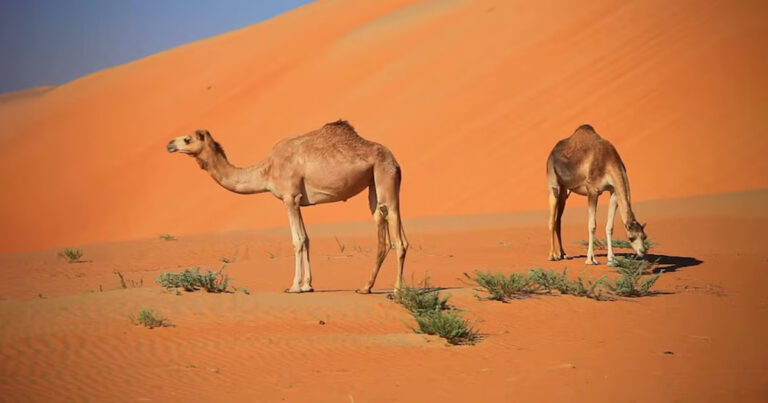
In the remote southeastern region of Iran lies a land so fiercely hot and eerily barren that it often resembles the surface of another planet. Known as the Lut Desert—or Dasht-e-Lut in Persian—this remarkable natural wonder holds the record for the hottest surface temperature ever recorded on Earth. But beyond its blistering heat and alien landscape, the Lut Desert is a silent witness to a once-thriving ancient civilization and a geologic marvel that continues to intrigue scientists and explorers alike.
🔥 A Hellish Climate: Earth’s Furnace
The Lut Desert, whose name is derived from Persian—“Lut” meaning “bare” or “void of vegetation” and “Dasht” meaning “plain”—is no ordinary desert. Spanning approximately 51,800 square kilometers, this arid land stretches across Iran’s Kerman and Sistan and Baluchestan provinces. It ranks among the most extreme hot and dry environments on the planet.
In 2005, NASA satellites recorded a ground surface temperature of 70.7°C (159.3°F) in this desert, specifically in a region called Gandom Beryan, making it the hottest ground temperature ever measured on Earth. Notably, this is not the ambient air temperature, but the land surface temperature, which can skyrocket under direct sunlight in areas with dark, rocky terrain.
Between June and October, the Lut becomes virtually uninhabitable. Dry, fierce winds blow relentlessly across the sand and salt plains, scouring the surface and preventing the accumulation of any organic life. The region receives almost no rainfall year-round, making it one of the driest deserts on Earth as well.
🌋 Gandom Beryan: The Scorched Land of Lava
The heart of Lut’s inferno lies in an area ominously named Gandom Beryan, which translates to “Toasted Wheat”. Covering roughly 480 square kilometers, this plateau is blanketed in black volcanic rock, a major reason for the area’s extreme heat retention.
This terrain absorbs and traps solar radiation during the day, causing temperatures to soar to levels where smartphones, cameras, and even scientific equipment automatically shut down to avoid heat damage. Travelers and scientists who dare to enter this zone must wear heat-resistant gear; it’s said that even rubber-soled shoes can begin to melt under the intense heat.
🏺 A Window to the Bronze Age
Despite its current desolation, the Lut Desert harbors a deep archaeological significance. Along its western edge lies the ancient city of Shahdad, believed to have flourished around 2500 BCE during the Bronze Age.
In 1968, Iranian archaeologist Ali Hakemi unearthed this site, revealing remarkably preserved artifacts—including metal tools, stone axes, decorative ornaments, pottery, and even children’s toys. These discoveries suggest that an advanced civilization once thrived in this seemingly inhospitable place.
Recent surveys by Iranian archaeological teams have identified 87 historical sites throughout the Lut region. These sites range from the 5th millennium BCE through to the Islamic era, offering a rare and continuous historical record of human adaptation in extreme climates.
🌊 From Ancient Sea to Desert Wasteland
The geography of the Lut Desert also tells the story of climate transformation. Geological studies suggest that the eastern parts of the desert were once submerged beneath an ancient inland sea known as “Tis”. Over millennia, shifts in climate led to the evaporation of these waters, leaving behind a vast salt plain and dry basin that form much of the desert’s unique terrain today.
Among the most stunning natural formations are yardangs—wind-carved ridges and valleys that stretch for kilometers and resemble alien landscapes. These structures are not only visually spectacular but also offer insight into erosional processes and wind patterns in hyper-arid environments.
🏆 A UNESCO World Heritage Site
In July 2016, the Lut Desert was designated as a UNESCO World Heritage Site, marking the first natural site in Iran to receive this prestigious recognition.
UNESCO cited the desert’s unique geomorphology, extreme climate, and archaeological significance as grounds for inclusion. The acknowledgment placed Lut in the global spotlight, surpassing even California’s Death Valley, long thought to be Earth’s hottest spot.
🧪 A Living Laboratory for Climate Scientists
For scientists studying climate change, planetary geology, and extreme ecosystems, the Lut Desert offers an invaluable natural laboratory. Its conditions mimic those found on Mars and other celestial bodies, leading space agencies like NASA and ESA to use the region as a testing ground for rover technologies and environmental resilience studies.
Furthermore, researchers are investigating microbial life forms that might exist in the soil and rocks of Lut. If found, these extremophiles could have profound implications for astrobiology—the search for life beyond Earth.
🧭 Adventure, Caution, and Curiosity
In recent years, the Lut Desert has also gained popularity among extreme travelers, photographers, and desert trekkers, drawn by its otherworldly beauty and the thrill of venturing into the unknown. However, navigating this landscape without proper equipment and guidance is highly dangerous.
Government restrictions and seasonal advisories are strictly enforced, and any exploration into deep desert zones requires permits and expert supervision.
🌱 Lessons in Sustainability and Climate Vigilance
The transformation of the Lut Desert from a sea-filled region to a scorched wilderness offers stark evidence of climate dynamics over millennia. It stands as a cautionary reminder of how planetary ecosystems can shift dramatically in response to long-term climate changes.
In an age when global temperatures are rising and arid zones are expanding, the Lut Desert serves as a visual prophecy of possible futures. Its existence urges policymakers, scientists, and citizens alike to reflect on sustainability, water security, and ecological balance.
📜 Conclusion: A Fiery Testament to Earth’s Extremes
The Lut Desert is more than just a hotspot on the map—it’s a profound symbol of Earth’s power, a repository of ancient human resilience, and a blazing monument to the extremes of nature.
Whether approached as a scientific enigma, a cultural treasure, or an environmental warning, the Lut Desert compels awe and demands respect. From its baking basalt plateaus to its whispering dunes, from the bones of buried cities to the silence of an empty sky, the Lut is a place where history, science, and mystery converge.
In its silence lies a story—the story of Earth’s heat, humanity’s endurance, and the fragile line between thriving and vanishing.