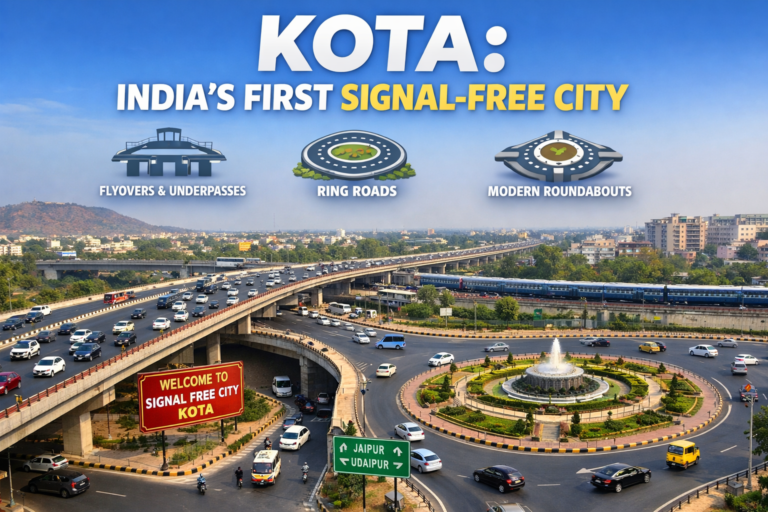
India’s First Signal-Free City: In a country where traffic lights, blaring horns, and endless congestion define daily commuting, one Indian city has quietly achieved what once seemed impossible. Kota, a mid-sized city in Rajasthan, has emerged as India’s first fully signal-free city, transforming its road network into a model of uninterrupted traffic flow through smart infrastructure rather than electronic control.
This radical shift did not rely on artificial intelligence, surveillance cameras, or adaptive traffic lights. Instead, it was powered by something far more fundamental: urban design. Through flyovers, underpasses, ring roads, and modern roundabouts, Kota has demonstrated that congestion is not merely a problem of traffic volume—but of planning philosophy.
At a time when India’s cities are struggling under rapid urbanization, Kota’s experiment offers a powerful blueprint for the future of urban mobility.
A City Known for Education, Now Known for Innovation
Kota has long been famous as India’s coaching capital, attracting hundreds of thousands of students each year preparing for competitive examinations. This influx, combined with growing local population and vehicle ownership, once pushed the city’s road infrastructure to its limits.
Until a few years ago, Kota faced challenges familiar to most Indian cities:
- Choked intersections
- Long waiting times at traffic signals
- Rising road accidents
- Fuel wastage from frequent stopping and idling
Rather than continuously adding traffic lights or deploying traffic police at every major junction, city planners began asking a different question: What if vehicles never had to stop at all?
The Vision Behind the Transformation
The answer came from the Urban Improvement Trust (UIT), Kota, which spearheaded a long-term vision focused on redesigning traffic movement itself. The core idea was simple yet revolutionary: traffic should flow naturally, not be forced to halt.
Instead of controlling vehicles through signals, UIT focused on eliminating conflict points—those intersections where vehicles cross paths and must be regulated. The solution lay in grade separation, directional flow, and geometric road design.
This approach marked a departure from the signal-centric mindset common across Indian cities.
Flyovers and Underpasses: Taking Traffic Off the Conflict Plane
The backbone of Kota’s signal-free system is its extensive network of flyovers and underpasses.
At major intersections and high-traffic corridors, flyovers allow vehicles to pass above congested zones, while underpasses carry traffic below surface intersections. By separating traffic vertically, the city eliminated the need for signals at many critical junctions.
Why This Matters
- Vehicles no longer intersect at the same level
- Chances of collision are significantly reduced
- Traffic maintains momentum without sudden stops
These structures were strategically placed after detailed traffic flow studies, ensuring that the busiest routes received priority treatment.
Ring Roads: Keeping Through-Traffic Out of the City Core
Another crucial element of Kota’s success is its ring road system.
Heavy vehicles, long-distance buses, and through-traffic were once forced to pass through the heart of the city, worsening congestion. The ring roads now provide an alternative route that allows such vehicles to bypass central areas entirely.
Key Benefits of Ring Roads
- Reduced pressure on inner-city roads
- Lower noise and air pollution in residential zones
- Faster travel for long-distance commuters
By redirecting non-local traffic, Kota ensured that city streets remain accessible primarily for residents, students, and local commerce.
Modern Roundabouts: Redefining Junction Management
Where flyovers or underpasses were not feasible, Kota introduced modern roundabouts, designed using international traffic engineering principles.
Unlike traditional chaotic circles, these roundabouts feature:
- Clearly marked lanes
- Controlled entry points
- Proper signage and visibility
Vehicles slow down slightly but do not stop, yielding smoothly to circulating traffic. This reduces delays while maintaining safety.
Roundabouts also eliminate common problems associated with traffic lights, such as signal jumping, sudden braking, and rear-end collisions.
The Design-First Philosophy
What truly sets Kota apart is its design-first approach.
Rather than installing signals first and fixing congestion later, planners focused on:
- Anticipating traffic growth
- Studying vehicle behavior patterns
- Designing roads that guide movement intuitively
This philosophy treats infrastructure as a silent regulator—one that directs traffic naturally without constant enforcement or electronic intervention.
It is a reminder that technology cannot compensate for poor design, but good design can often replace technology altogether.
The Impact: A City That Moves
The results of Kota’s signal-free transformation are tangible and far-reaching.
Uninterrupted Traffic Flow
Vehicles move continuously across major corridors, cutting down travel time significantly. Commutes that once took 30–40 minutes are now completed in nearly half the time.
Reduced Fuel Consumption
Frequent stopping and restarting of vehicles is one of the biggest causes of fuel wastage. With fewer halts, fuel efficiency has improved across private and commercial vehicles alike.
Lower Emissions
Reduced idling has led to a measurable drop in vehicular emissions, contributing to better air quality and a smaller carbon footprint.
Improved Road Safety
Fewer intersections, fewer signals, and smoother movement have resulted in a decline in traffic accidents, particularly those caused by sudden braking or signal violations.
Economic and Social Benefits
Beyond traffic metrics, the signal-free model has delivered broader economic and social gains.
- Productivity Boost: Less time on roads means more time for work, education, and family.
- Lower Transport Costs: Fuel savings benefit individuals and logistics operators alike.
- Stress Reduction: Smoother driving conditions improve mental well-being for commuters.
Local businesses have also benefited from better accessibility and reduced delivery delays.
A Blueprint for India’s Urban Future
India is urbanizing at an unprecedented pace. By 2030, nearly 40% of the population is expected to live in cities. Traffic congestion already costs Indian cities billions of rupees annually in lost productivity and fuel.
Kota’s experience offers a powerful lesson:
Urban mobility challenges cannot be solved by signals alone.
Cities like Delhi, Bengaluru, Mumbai, and Kolkata—each struggling with gridlock—could adapt elements of the Kota model, tailored to their scale and geography.
While not every junction can be made signal-free, strategic use of grade separation and ring roads can drastically reduce dependence on traffic lights.
Challenges and Realities
It is important to note that Kota’s transformation was neither quick nor inexpensive. Building flyovers and underpasses requires significant investment, land acquisition, and long-term planning.
However, experts argue that these costs must be weighed against:
- Long-term fuel savings
- Reduced accident-related expenses
- Environmental benefits
- Improved quality of life
In this context, Kota’s investment appears less like an expense and more like a forward-looking asset.
Looking Ahead: The Future of Signal-Free Cities
Urban planners believe that the future lies in hybrid models, where well-designed infrastructure minimizes the need for signals, and smart technology complements—not controls—traffic flow.
Kota has proven that a city does not need to be a megacity to be innovative. With vision, planning, and political will, even mid-sized cities can lead national transformation.
Conclusion: When Roads Think for Themselves
Kota’s signal-free journey is not merely a traffic success story—it is a shift in mindset. It challenges the assumption that congestion is inevitable and demonstrates that cities move better when roads are designed to think ahead.
By choosing infrastructure over intervention, Kota has shown India—and the world—that the future of urban mobility may not lie in more lights, but in fewer reasons to stop.
As Indian cities search for sustainable, scalable solutions to their growing mobility crisis, Kota stands as a living example of what is possible when planning leads the way.
Read More: Job Fair Success in Bardhaman: 49 Offer Letters Issued as 16 Companies Participate
[…] Read More: India’s First Signal-Free City: How Kota Rewrote the Rules of Urban Traffic […]