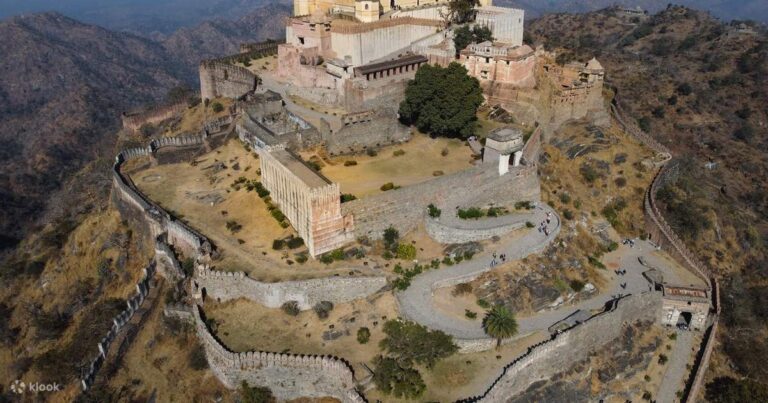
While the world marvels at the Great Wall of China, nestled amidst the rugged folds of Rajasthan’s Aravalli hills lies an equally astonishing monument — the Kumbhalgarh Fort. Often referred to as “India’s Great Wall”, the fort is girdled by an astonishing 36-kilometre-long wall, earning it the recognition of being the second-longest continuous wall in the world.
But this is not merely a marvel of masonry. Kumbhalgarh is a living embodiment of Rajput valor, strategic genius, spiritual sacrifice, and cultural heritage. Every stone of this mighty fort tells a tale — of resistance, of pride, of an unbreakable will to remain free.
🔹 A Fortress Carved in Courage
Constructed in the 15th century by Rana Kumbha, one of the most powerful rulers of Mewar, the fort stands at an altitude of approximately 3600 feet above sea level in the Rajsamand district of Rajasthan. Strategically perched in the Aravalli range, Kumbhalgarh served not just as a military bastion but also as a refuge and retreat for Mewar rulers in times of invasion.
This ancient stronghold isn’t just famous for its architecture or military design—it is celebrated as the birthplace of Maharana Pratap, the legendary Rajput warrior who fiercely resisted the Mughal Empire and is remembered as a symbol of unyielding patriotism and honor.
🧱 The Great Wall of India
The most captivating feature of Kumbhalgarh is its massive encircling wall, stretching 36 kilometers across undulating hills and forests. Constructed using massive stone blocks, the wall is 15 feet thick in most places—so wide that five horses could march side-by-side atop it.
Despite its incredible size, the wall remained relatively unknown to the outside world until recent decades. Today, it stands as a symbol of India’s engineering prowess and defensive ingenuity from an era long before modern warfare.
⚔️ Impregnable Defense and Tactical Brilliance
In 1532, an alliance comprising Mughal emperor Humayun, the Sultan of Gujarat, and the ruler of Malwa launched a formidable attack on Kumbhalgarh. But their efforts were in vain. The fort’s design, combined with its difficult terrain, secret passageways, and deceptive entryways, rendered the structure nearly impenetrable.
The layout of Kumbhalgarh ensured that even under siege, it could hold out for months, if not years. Hidden tunnels, concealed trapdoors, zigzag entry points, and natural obstacles like cliffs and dense forests added layers of protection that thwarted even the most calculated invasions.
💧 Sustainable Living: The 84 Reservoirs
In a desert state where water scarcity is perennial, Kumbhalgarh’s designers showcased visionary planning. The fort housed 84 water reservoirs, including both natural and artificial tanks, that ensured a constant and self-replenishing water supply even during prolonged sieges.
These reservoirs were ingeniously designed to harvest rainwater, store it in stone cisterns, and circulate it throughout the fort. It is believed that the residents could live self-sufficiently inside the fort for years, thanks to this advanced water management system.
🛕 A Tale of Sacrifice: The Legend of the Human Offering
Kumbhalgarh’s history is not just built on stones but also on spiritual sacrifice. Historical records and folklore recount that during the fort’s initial construction phase, every attempt to build the structure failed—it would collapse inexplicably.
It was then that a sage predicted that the fort would only stand if a human volunteered to be sacrificed. A devout hermit stepped forward, and as per the ritual, his head was severed and where it fell, a temple was built. His body was carried uphill, and the spot it collapsed marked the fort’s foundation.
This poignant tale gave birth to the term ‘Garbha-Prakaar’, or the Womb Wall, symbolizing the spiritual womb from which the fort emerged.
🌄 Nature as Ally: A Strategic Geographic Masterstroke
Kumbhalgarh was more than a fort — it was a natural citadel. Located in the heart of the Aravalli Hills, it was virtually invisible from a distance, camouflaged by its surrounding terrain. Thick forests, sheer cliffs, narrow ridges, and treacherous passes served as natural barriers, fortifying the fort against surprise attacks.
Its high elevation gave defenders an unobstructed view of surrounding valleys, allowing early detection of any advancing enemy forces. In military strategy, this location was priceless.
🎖️ A Symbol of Culture, Valor, and Devotion
Inside the fort, one finds more than 300 temples, both Hindu and Jain, showcasing the fort’s pluralistic character. The architecture of these temples reflects the artistic excellence of the time, with intricately carved domes, pillars, and deities standing testimony to India’s rich spiritual traditions.
Moreover, every stone, stair, and stupa seems to echo stories of Rajput chivalry, their code of honor, and their resolute refusal to kneel before tyranny.
🏆 Kumbhalgarh Today: Heritage That Stands Unmoved
Designated as a UNESCO World Heritage Site as part of the Hill Forts of Rajasthan, Kumbhalgarh today draws historians, architects, and travelers from across the globe. Guided walks along the massive wall, panoramic sunset views from the ramparts, and quiet moments in its ancient temples together create a timeless experience.
But beyond tourism, Kumbhalgarh serves as an enduring reminder of India’s indomitable spirit. It is a monument to resilience, an epic in stone, and a tribute to a people who would rather die than surrender.
🔚 Conclusion: A Wall That Defies Time
In a world racing forward, the wall of Kumbhalgarh stands silently — a stoic witness to centuries gone by. Weathered by storms, sun, and sand, it does not crumble. It remains resolute, proud, and eternal.
To many, it’s just a fort. But to those who walk its sacred grounds, Kumbhalgarh is a heartbeat of ancient India — where bravery was everyday life, and freedom was worth more than life itself.