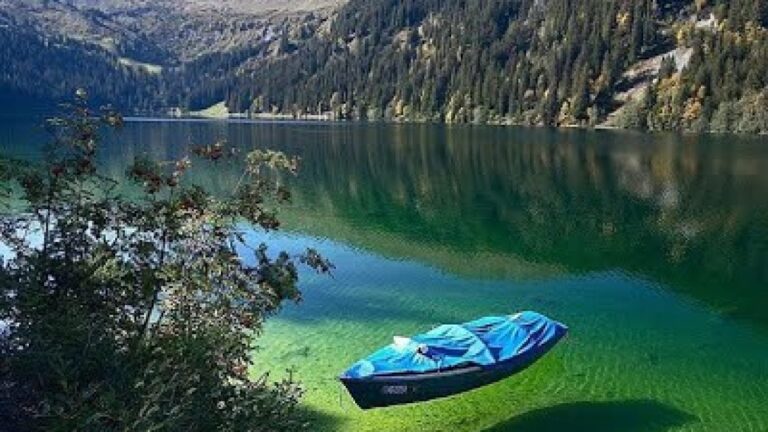
Hidden in the icy heart of Siberia lies Lake Baikal, one of the most mysterious and fascinating water bodies on Earth. This awe-inspiring lake is not just the deepest in the world but also the oldest, dating back an astonishing 25 million years. Formed due to a massive rift in the Earth’s crust, Baikal continues to expand at a rate of approximately 2 centimeters per year, making it a living, evolving geological wonder.
But what makes Lake Baikal even more enigmatic is not just its depth—1,642 meters—but its unparalleled clarity, unique ecosystem, and tectonic activity, which could one day reshape the landscape of an entire continent.
A Geological Marvel: The Birth and Expansion of Baikal
Around 25 million years ago, the Earth’s crust cracked open in a dramatic geological event, forming a vast rift valley. Over time, this rift filled with water, giving birth to Lake Baikal. What makes it unique is that it sits between two tectonic plates that are slowly moving apart.
Unlike other lakes that shrink over time, Baikal is continuously expanding, leading some scientists to believe that it could one day split the Eurasian continent in two! Some theories even suggest that in millions of years, Baikal may transform into a new ocean.
Crystal Clear Waters: A Window to the Depths
One of the most striking features of Lake Baikal is its incredible water clarity. In summer, visibility can extend up to 40 meters below the surface! The water remains pristine due to a unique natural filtration system maintained by the lake’s microscopic organisms, which consume impurities.
Even in winter, when the lake freezes over, its transparent ice allows people to see deep into its depths. The frozen surface forms stunning crystal-clear ice sheets, with patterns of trapped air bubbles and frozen cracks, making it look like a landscape from another world.
A Lake in Motion: Tectonic Activity Beneath the Ice
Beneath Baikal’s serene waters lies a restless world. Unlike most lakes that sit on stable ground, Baikal rests on shifting tectonic plates that continue to move, causing frequent earthquakes and the formation of new cracks on the lakebed.
Scientists believe that this movement is a sign that Baikal is still growing and changing. One day, the shifting plates could dramatically reshape Siberia’s geography, proving that this lake is not just a relic of the past but a force that continues to shape the Earth’s future.
An Ecosystem Like No Other
Lake Baikal is home to an extraordinary array of life, including species found nowhere else on Earth. With more than 1,000 plant and animal species, about 80% of them are endemic to this lake, meaning they exist only in Baikal.
Perhaps the most mysterious creature in this lake is the Baikal seal (Nerpa)—the only freshwater seal species in the world. How these seals arrived in Baikal, which is surrounded by land, remains a puzzle. Some theories suggest they traveled through ancient rivers, while others speculate they adapted to freshwater over thousands of years.
Apart from the Baikal seal, the lake is also home to a variety of fish, microscopic crustaceans that help keep the water clean, and the legendary omul fish, which is a delicacy in the region.
A Chameleon Lake: Changing Colors with the Seasons
Lake Baikal is often referred to as a “chameleon lake” because its water changes color with the seasons.
- Winter – The lake appears deep blue, with stunning frozen formations.
- Spring – The water turns a vibrant green due to algae blooms.
- Summer – The lake takes on a golden hue, reflecting the sunlight.
- Autumn – Baikal often appears black, giving it an eerie yet mesmerizing look.
Scientists believe this phenomenon is caused by seasonal changes in the lake’s ecosystem, variations in algae levels, and shifting mineral compositions in the water.
A UNESCO World Heritage Site
Recognizing its extraordinary ecological and geological significance, UNESCO declared Lake Baikal a World Heritage Site in 1996. The lake is not only a scientific treasure but also a spiritual and cultural icon for the local Buryat people, who consider it a sacred body of water.
A Paradise in Danger: The Growing Environmental Threat
Despite its untouched beauty, Lake Baikal faces serious environmental threats. Industrial pollution, climate change, and increasing tourism are putting immense pressure on this fragile ecosystem. Scientists have already recorded a decline in some fish populations, and the lake’s famous clarity is slowly decreasing due to pollution.
The rise in toxic algae blooms is another alarming sign. These blooms, caused by rising temperatures and chemical waste, threaten the unique species that have called Baikal home for millions of years.
Can We Save Baikal?
Environmentalists and scientists are calling for stronger conservation efforts to protect Baikal from further damage. Some possible solutions include:
✔ Stricter regulations on industrial waste dumping.
✔ Sustainable tourism to prevent overexploitation.
✔ Scientific monitoring to track ecological changes.
✔ Raising awareness about the importance of preserving this natural wonder.
Conclusion: Baikal—A Living Wonder of the World
Lake Baikal is more than just a lake—it is a time capsule of Earth’s history, a laboratory for scientists, and a breathtaking natural wonder. It holds some of the purest water on the planet, shelters one-of-a-kind creatures, and continuously reshapes the Earth beneath it.
However, the future of Baikal is uncertain. If we fail to protect and preserve this unique ecosystem, one of Earth’s greatest natural treasures may be lost forever. It is up to humanity to ensure that Baikal’s mysteries remain for generations to come—a reminder of nature’s power and fragility.