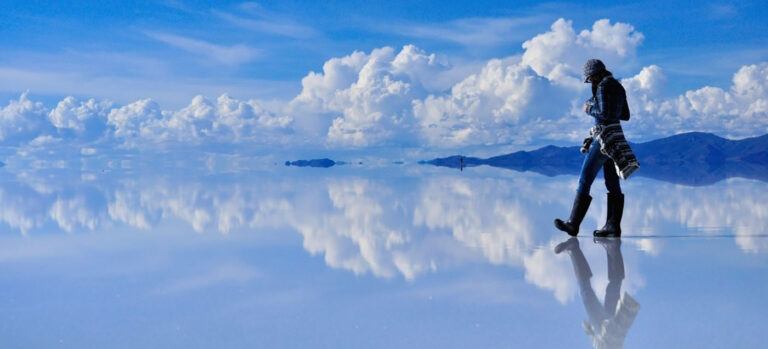
There are places on Earth so surreal, they blur the line between fantasy and reality. Nestled in the southwest of Bolivia lies one such natural marvel—Salar de Uyuni, the world’s largest salt flat. Spanning a staggering 10,582 square kilometers, this endless white desert transforms during the rainy season into something truly magical: a mirror so perfect, it reflects the sky with astonishing clarity, creating the illusion of walking on air.
🧭 Where Earth Meets Sky
Salar de Uyuni lies high up on the Altiplano, a vast plateau in the Andes mountains, at an elevation of approximately 3,656 meters (11,995 feet) above sea level. The landscape is flat as far as the eye can see—so much so that it’s one of the flattest places on Earth. At first glance, it might seem barren, but this place holds geological, ecological, and even technological significance.
🕰️ A Journey Through Time: How Was It Formed?
Around 30,000 to 40,000 years ago, this region was submerged beneath a massive prehistoric lake known as Lake Minchin. Over millennia, the lake evaporated, leaving behind two smaller lakes (Poopó and Uru Uru) and two vast salt flats: Salar de Coipasa and the grander Salar de Uyuni. What remains today is a thick crust of salt, sitting atop lithium-rich brine and clay.
In fact, Salar de Uyuni is believed to hold 50–70% of the world’s known lithium reserves, making it a strategic resource for the modern world—particularly in the production of lithium-ion batteries for electric vehicles and renewable energy storage.
💦 The Mirror Illusion: Nature’s Optical Masterpiece
What truly sets Salar de Uyuni apart, however, is what happens during the wet season (December to March). A thin sheet of rainwater collects on the flat salt surface, creating a mirror effect so perfect that it reflects the sky like polished glass. It becomes difficult to distinguish where the earth ends and the sky begins.
This natural illusion is the result of a rare combination of factors:
- Extraordinarily Flat Surface: Salar de Uyuni is so level that it deviates by less than a meter over its entire area.
- Bright White Salt Crust: The salt reflects sunlight with incredible efficiency.
- Thin Layer of Standing Water: During the rainy season, this shallow layer transforms the salt flat into a colossal mirror.
From above, it looks like clouds are floating below the plane. From the ground, it’s a mesmerizing infinity of sky, clouds, and self-reflection—literally and metaphorically.
📸 A Photographer’s Paradise
It’s no wonder that Salar de Uyuni has become a global magnet for photographers, artists, and filmmakers. At sunrise and sunset, when colors are at their most vivid, the landscape glows with hues of gold, pink, and violet—blending the heavens and earth in a dreamlike spectacle.
Tourists and creatives from around the world come here to capture mind-bending perspective photos: holding up cars with one hand, appearing gigantic next to tiny figures, or creating symmetrical scenes where people appear to float in the clouds.
Whether you’re a travel blogger, influencer, or casual adventurer, this salt flat offers a once-in-a-lifetime canvas for imagination.
🚗 Getting There: The Gateway to Another World
The main access point to Salar de Uyuni is through Uyuni town, a small settlement in Bolivia that acts as the tourist base. From here, travelers can book guided jeep tours ranging from one-day excursions to multi-day adventures, which also include visits to surrounding wonders such as:
- Train Graveyard – A surreal collection of rusted locomotives from the 19th century
- Laguna Colorada – A red-colored lake home to flamingos
- Laguna Verde – A greenish mineral lake at the base of a volcano
- Geyser Fields and Hot Springs – Where geothermal forces bubble up from the Earth’s core
And for those seeking an unforgettable stay, the region is home to the Palacio de Sal (Palace of Salt)—a hotel entirely constructed from blocks of salt, including furniture, walls, and even the beds.
🔬 Scientific Significance Beyond Beauty
Though tourists flock to see the mirror effect, Salar de Uyuni serves more than aesthetic or recreational purposes. It is of major scientific importance:
- Satellite Calibration: Owing to its near-perfect flatness, the surface is used to calibrate the altimeters of Earth-observing satellites like NASA’s.
- Climate Studies: Researchers study the region to monitor environmental changes and gather data related to global warming.
- Lithium Exploration: With the world transitioning to cleaner energy, the salt flat’s vast lithium reserves could play a key role in building sustainable energy systems.
This convergence of ecological, scientific, and technological relevance makes Salar de Uyuni not just a wonder to behold, but a location of global consequence.
💫 A Place That Transcends Geography
Salar de Uyuni is more than a destination—it’s an experience that reshapes your perception of reality. Standing on its reflective surface, you feel suspended in a liminal space between heaven and earth. It evokes awe, introspection, and a profound appreciation for the natural world’s artistry.
In an era of photo filters and virtual reality, this is one place where nature outperforms imagination. It’s not edited. It’s not enhanced. It’s simply real—perhaps too real to believe at first glance.
🧳 Final Thoughts: Why You Must Visit
If you’re planning your next big adventure, consider timing your trip with Bolivia’s rainy season to witness Salar de Uyuni in its full reflective glory. Bring your camera, your curiosity, and your sense of wonder.