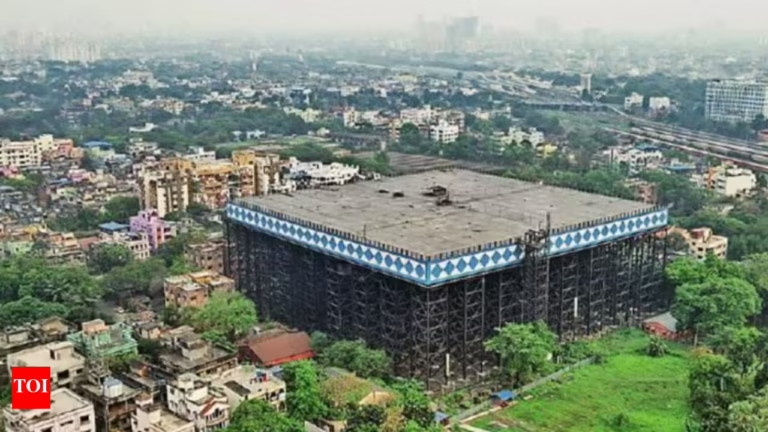
The Astonishing Tala Tank: Kolkata is often described as a city of heritage, intellect, culture, literature, trams, and timeless debates. Yet hidden behind this vibrant identity lies a monumental structure that has quietly sustained the city for more than a century. It does not attract tourists, it rarely features in postcards, and it stands without architectural glamour. Still, without it, modern Kolkata would struggle to survive. This extraordinary structure is the Tala Tank, the largest overhead water reservoir not only in India but in the world.
The Tala Tank is not merely a utility building—it is a story of foresight, engineering brilliance, resilience during war, and the unquestionable importance of water in shaping civilization.
The Early Kolkata and the Urgent Need for Water
To understand the significance of the Tala Tank, one must first revisit the birth of Kolkata itself. In 1717, the East India Company received rights over 38 villages from Mughal Emperor Farrukhsiyar. Out of these, 33 villages eventually formed what we know today as Kolkata.
As trade expanded and colonial administration grew, Kolkata rapidly transformed from a cluster of rural settlements into a flourishing urban center. With population growth came an inevitable challenge—access to safe drinking water. In those early days, waterborne diseases like cholera, dysentery, and typhoid posed severe threats to public health.
Initial solutions were modest. Large ponds were excavated in areas such as Hedua, Bhowanipore, and Wellington to supply water to residents. However, these sources soon became insufficient for a city that was growing both geographically and demographically.
By the late 19th century, it became clear that Kolkata needed a systematic, centralized, and modern water supply mechanism—something far more ambitious than ponds and open reservoirs.
A Vision Takes Shape: The Birth of the Tala Tank Concept
In 1901, a man named Mr. Deveral proposed the construction of a massive overhead water tank capable of serving large parts of the city. This proposal marked a turning point in Kolkata’s civic planning. Recognizing the urgency, the Kolkata Corporation approved the plan in 1902.
In 1903, engineer W. B. McCabe modified and refined the design to enhance capacity and durability. The estimated cost for the project at the time was an impressive 6,917,874 rupees, a sum that reflected both the scale of the project and the ambition behind it. For its time, this was a monumental investment in public health and urban infrastructure.
Finding a Home for a Giant
One of the biggest challenges was location. Where could such a massive structure be built?
The answer lay in northern Kolkata, in an area that was once dotted with ponds and wetlands. These water bodies were gradually filled in to create a stable base for construction. The land—spanning an astonishing 482 acres—was donated by a benevolent individual named Babu Khelat Chandra Ghosh.
On this donated land rose a structure equivalent in height to a ten-storey building, destined to become the backbone of Kolkata’s water supply system.
From Foundation to Reality
The foundation stone of the Tala Tank was laid in 1909 by then Governor Sir Edward Baker. After two years of complex engineering and meticulous construction, the tank was officially commissioned in 1911 and opened for public water supply.
From that moment onward, Tala Tank began fulfilling its quiet but critical role—ensuring that clean water reached homes across the city.
Engineering That Defied Its Time
What sets the Tala Tank apart from nearly every other water reservoir in the world is its extraordinary construction technique.
The tank is a perfect square, measuring 321 feet by 321 feet, and was built entirely on a wooden platform—without the use of screws. This method allowed the structure to absorb natural vibrations and movements, making it remarkably resilient.
Originally, the roof was made of lime-surki, a traditional mixture widely used before modern concrete became common. Later, it was reinforced with 14-inch-thick concrete, further strengthening the structure.
The sheer scale of the tank is difficult to visualize. With an area of 103,041 square feet, it is so massive that a full-sized football stadium could comfortably fit inside it.
The Minds and Hands Behind the Marvel
Several renowned companies and engineers contributed to building this colossal structure:
-
Foundation work was carried out by T. C. Mukherjee & Company
-
Concrete foundation was executed by Martin & Company, led by Rajendralal Mukherjee
-
Steel construction was handled by Clittenson & Company from England
-
Later roof reinforcement was completed by Arakan & Company along with Kali Shankar Mittir
Interestingly, the steel used in the Tala Tank was of the same high quality as that used in constructing the legendary Titanic—a testament to the durability and strength envisioned by its designers.
Capacity and Water Distribution System
The Tala Tank consists of four separate compartments, a critical feature that allows maintenance and cleaning without disrupting the city’s water supply. This thoughtful design reflects the extraordinary foresight of its engineers.
Key specifications:
-
Total water capacity: 9 million gallons
-
Total height of the structure: 18 feet
-
Operational water depth: 16 feet
Water stored in the Tala Tank travels through an extensive underground pipeline network, supplying areas from Dum Dum in the north to Bhowanipore in the south. For decades, this silent system has delivered life-sustaining water to millions of Kolkata residents every single day.
A Structure That Refused to Fall
The true greatness of the Tala Tank lies not only in its size, but in its unyielding resilience.
During the Second World War, Japanese air raids bombed several locations across Kolkata. The Tala Tank was hit, yet it did not collapse. Only nine holes were recorded—minor damage considering the destructive power of aerial bombs.
The tank has also withstood multiple major earthquakes without suffering serious structural harm.
In the wars of 1962 and 1971, both China and Pakistan reportedly identified the Tala Tank as a potential strategic target. The reasoning was simple: disabling the water supply would bring the city to a standstill. Yet, despite looming threats and turbulent times, the Tala Tank remained secure and functional.
More Than a Structure: A Lifeline
In modern times, when advanced filtration plants and newer reservoirs exist, one might wonder whether an old tank like Tala still matters. The answer is a resounding yes.
The Tala Tank is not just a water reservoir—it is a symbol of sustainable planning. Built over 100 years ago, it continues to function efficiently without aggressive modernization. It stands as proof that when infrastructure is designed with long-term thinking, it can serve generations without failure.
The Silent Guardian of Kolkata
Every morning, as Kolkata wakes up to bustling streets, crowded buses, school bells, and office routines, the Tala Tank has already done its job. It asks for no recognition, no celebration, and no applause. It simply supplies water—day after day, year after year.
In an age where cities increasingly struggle with water scarcity, the Tala Tank offers an invaluable lesson: water security must be a priority, not an afterthought.
A Global Wonder Beneath the Ordinary
The Tala Tank may not feature in tourist brochures, but it deserves a place among the world’s most remarkable engineering achievements. It represents vision, endurance, and the fundamental truth that water is life.
As Kolkata moves into the future, surrounded by modern skyscrapers and expanding urban demands, this century-old giant continues to stand firm—a timeless reminder that the strongest foundations are built not just with iron and concrete, but with foresight and responsibility.
The Tala Tank is, and will remain, Kolkata’s silent guardian—sustaining life, one drop at a time.
Read More: Black Coffee: The Simple Brew Emerging as a Powerful Guardian of Modern Health
[…] Read More: The Astonishing Tala Tank: Kolkata’s Silent Giant That Keeps the City Alive […]