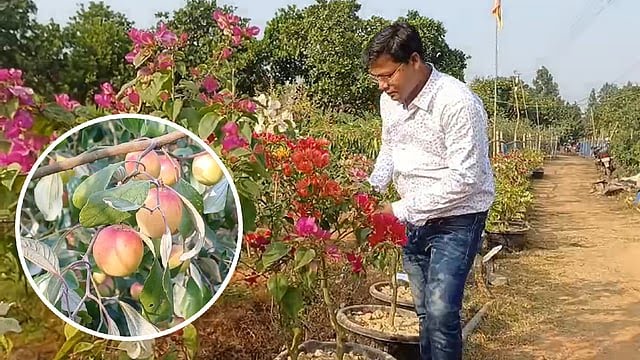
Cultivating Gold: In the heart of Bengal’s Junglemahal, where the soil is famously red, dry, and often deemed “unfit” for lush farming, a quiet revolution is blooming. Prashanta Kumar Das, a dedicated professor at Seva Bharati Mahavidyalaya (affiliated with Vidyasagar University), is proving that with innovation and organic methods, even the harshest terrains can yield a fortune.
Through his ambitious project, Professor Das is not just growing fruit; he is cultivating a roadmap for the unemployed youth of the region.
The “Forest Park” Initiative
Partnering with the Midnapore Sadar Panchayat Samiti, Professor Das leased 14 acres of land in the Delua area to establish “Forest Park.” This dream project serves as a live demonstration of integrated agriculture and horticulture.
At the center of this success story is the “Bharat Sundari” Kul (Jujube). While they look like miniature apples—earning them the nickname “Apple-Kul”—these fruits are thriving in the arid soil.
Scale: 5 bighas of land dedicated specifically to Kul cultivation.
Technique: 100% organic fertilizers.
Financials: With an investment of roughly ₹24,000 to ₹25,000 per bigha, the Professor expects a return of nearly ₹1 Lakh per bigha.
By the end of December, the farm had already recorded sales worth nearly ₹2 Lakhs, with expectations to double that figure by the end of January.
Mangoes in Winter: Defying the Seasons
Perhaps the most striking feature of Forest Park is the sight of mangoes hanging from trees in the peak of winter. Professor Das has successfully cultivated the “Katimon” Mango, an “all-time” variety that harvests twice a year.
His orchard isn’t limited to local varieties; it boasts some of the world’s most premium mangoes, including:
Miyazaki (Japan’s “Egg of the Sun”)
Red Palmer
Red Ivory
In addition to these, the farm produces high-quality papaya, guava, and a vibrant array of flowers, transforming a once-barren patch of land into a multi-colored oasis.
A Vision for the Youth: Srijani Agro Foundation
Professor Das’s goals extend beyond personal profit. He established the Srijani Agro Foundation to provide an “alternative income” model for the younger generation in Junglemahal.
“We want to show the youth that you don’t need fertile alluvial soil to succeed,” says Professor Das. “With integrated farming and organic methods, this red, dry earth can generate millions.”
Urmila Sau, President of the Midnapore Sadar Panchayat Samiti, lauded the initiative, noting that the project has already generated local employment and is inspiring young entrepreneurs to look at farming as a viable, high-profit career.
Conclusion
The success of Forest Park serves as a powerful case study in sustainable agriculture. It proves that the “unproductive” lands of West Bengal hold immense potential if matched with the right expertise and modern crop varieties. For the youth of Junglemahal, Professor Das has turned a dry landscape into a land of opportunity.
Read More: From Corporate Success to AIR 6: The Inspiring Journey of IAS Vishakha Yadav
[…] Read More: Cultivating Gold in Arid Lands: A Medinipur Professor’s Green Revolution […]