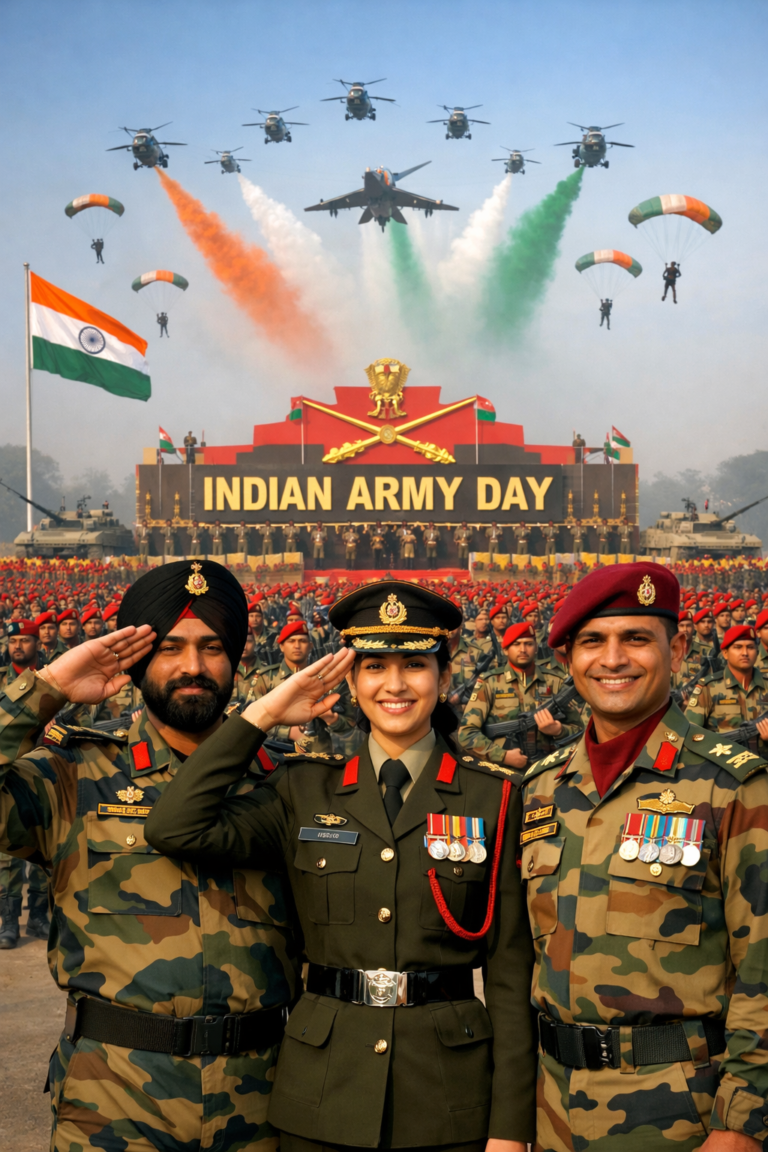
Indian Army Day is observed every year on 15 January across India with pride, respect, and a deep sense of patriotism. The day is dedicated to honoring the courage, discipline, sacrifice, and selfless service of the Indian Army. It is a national occasion to express gratitude to those soldiers who stand guard at the borders in extreme weather and hostile conditions, risking their lives so that the nation can live in peace and security.
On 15 January 1949, General K. M. Cariappa assumed office as the first Indian Commander-in-Chief of the Indian Army. This historic moment marked the complete transfer of military leadership from British officers to Indian hands after independence. To commemorate this landmark event and to recognize the invaluable contribution of the Indian Army, 15 January has been celebrated as Indian Army Day ever since.
The Indian Army is not only a war-fighting force; it is also a vital pillar of nation-building. From disaster relief and humanitarian assistance to peacekeeping missions across the world, the Army plays a crucial role in safeguarding the nation’s integrity, unity, and humanitarian values.
Historical Significance of Indian Army Day
At the time of India’s independence in 1947, the Indian Army was still under British command. General Sir Francis Butcher was the last British Commander-in-Chief of the Indian Army. Although Indian soldiers formed the backbone of the force, the highest leadership positions were held by foreign officers.
On 15 January 1949, General Butcher handed over command to Lieutenant General K. M. Cariappa. With this transition, India got its first Indian Army Chief, symbolizing true military sovereignty. General Cariappa laid strong emphasis on discipline, professionalism, and national character, shaping the Indian Army into a modern and respected institution.
To honor this defining moment in Indian military history, Indian Army Day is celebrated annually. On this day, grand parades, military demonstrations, wreath-laying ceremonies for martyrs, and felicitation of brave soldiers are organized in New Delhi at Kartavya Path and at military stations across the country.
Ancient Military Traditions of India
The roots of the Indian Army can be traced back to India’s ancient and rich military heritage. References to organized armies, war strategies, and weapons are found in the Vedic period as well as in the great epics—the Ramayana and the Mahabharata. The Kurukshetra War described in the Mahabharata reflects advanced military organization, formations, and strategic planning of that era.
One of the earliest examples of a well-structured military system in India was established by Chandragupta Maurya, the founder of the Mauryan Empire, under the guidance of his mentor Chanakya (Kautilya). Kautilya’s Arthashastra contains detailed discussions on military administration, intelligence networks, logistics, and warfare strategies, many of which remain relevant even today.
During the reign of Emperor Ashoka, the Mauryan Army was one of the most powerful forces of its time. Although Ashoka adopted the path of non-violence after the Kalinga War, the administrative efficiency and military discipline of the empire remained strong.
Subsequently, the Gupta Empire, Chola dynasty, Palas, Rajputs, and Marathas developed their own formidable military systems. The guerrilla warfare tactics of Chhatrapati Shivaji Maharaj are still studied in modern military academies for their effectiveness and innovation.
Medieval India and Military Organization
During the medieval period, India witnessed the rise of powerful military systems under the Delhi Sultanate and the Mughal Empire. Babur introduced effective use of artillery in Indian warfare, changing the nature of battles. Emperor Akbar strengthened the military-administrative structure through the Mansabdari system, which ensured efficient command, control, and resource management.
Akbar’s army was inclusive, comprising soldiers from diverse regions, religions, and communities. This diversity laid the foundation of a pluralistic military culture that continues to define the Indian Army today.
Colonial Era and the British Indian Army
The arrival of the East India Company marked a major transformation in India’s military history. Initially raised to protect commercial interests, the Company’s army gradually became the backbone of British colonial rule in India.
In the British Indian Army, Indian soldiers formed the majority, while senior command positions were largely occupied by British officers. Despite this imbalance, Indian soldiers earned global recognition for their bravery and professionalism, particularly during the First and Second World Wars, where they fought on multiple fronts across Europe, Africa, and Asia.
The Revolt of 1857, also known as the First War of Independence, was a turning point in Indian military history. It was not merely a mutiny but a widespread and organized resistance against foreign rule. The sacrifices made by Indian soldiers during this uprising remain etched in the nation’s collective memory.
Freedom Struggle and the Indian National Army
The Indian freedom movement also witnessed the rise of military consciousness. Under the leadership of Netaji Subhas Chandra Bose, the Indian National Army (INA), or Azad Hind Fauj, was formed to fight British rule with armed resistance. Netaji’s stirring call—“Give me blood, and I will give you freedom”—inspired thousands of Indians to join the cause.
Although the INA did not achieve decisive military success, the trials of INA officers after the war ignited a massive wave of patriotism across the country. This significantly weakened British authority and hastened India’s independence.
The Indian Army After Independence
After independence, the Indian Army faced numerous challenges, including the consequences of Partition, refugee crises, and unresolved border disputes. These early years tested the strength and resolve of the newly independent nation.
The 1947–48 Kashmir War
This was the first major conflict faced by the Indian Army. Despite limited resources, the Army displayed courage, resilience, and strategic competence in defending India’s territorial integrity.
The 1962 Sino-Indian War
The war with China proved to be a difficult chapter in Indian military history. Valuable lessons were learned, leading to significant reforms, modernization, and infrastructural development in the armed forces.
The 1965 and 1971 Indo-Pak Wars
The 1971 war stands as a defining moment, resulting in India’s decisive victory and the creation of Bangladesh. It remains one of the finest examples of joint military planning and execution in the region.
Organization, Discipline, and Core Values
The Indian Army is one of the largest volunteer forces in the world. It is organized into various commands, corps, divisions, and brigades. Infantry, Armoured Corps, Artillery, Engineers, Signals, Medical Corps, and Special Forces—all perform specialized roles with high levels of professionalism.
The guiding principle of the Indian Army is its motto: “Seva Paramo Dharma”—Service Before Self. This ethos inspires every soldier to place the nation above personal interest.
Modernization and Technological Advancement
In the 21st century, the nature of warfare has evolved rapidly. The Indian Army is continuously upgrading its capabilities by adopting advanced weapon systems, modern tanks, artillery, drones, cyber warfare tools, and space-based technologies.
Government initiatives such as Make in India and Aatmanirbhar Bharat are strengthening indigenous defense production and enhancing self-reliance in military technology.
Peacekeeping and Humanitarian Role
The Indian Army is among the largest contributors to United Nations peacekeeping missions. Indian peacekeepers have served with distinction in conflict zones across Africa and Asia, earning global respect for their professionalism and compassion.
Domestically, the Army plays a vital role in disaster response. During floods, earthquakes, cyclones, and other natural calamities, Indian Army personnel are often the first responders, saving lives and restoring hope.
Message of Army Day and the Future Generation
Indian Army Day reminds the nation that freedom and security are the result of countless sacrifices. It serves as a source of inspiration for the youth, instilling values of discipline, patriotism, courage, and responsibility toward the nation.
Indian Army Day stands as a symbol of national gratitude and pride. The history of the Indian Army is a saga of bravery, sacrifice, discipline, and unwavering commitment. Drawing strength from its glorious past, embracing modern technology in the present, and preparing for future challenges, the Indian Army will continue to remain the steadfast guardian of India’s sovereignty and unity.
Salutations to the soldiers of the Indian Army—the sentinels of our freedom, the protectors of peace, and the true pride of the nation.
Read More: CTC Tea vs. Leaf Tea: Which One Should You Choose for Your Health?