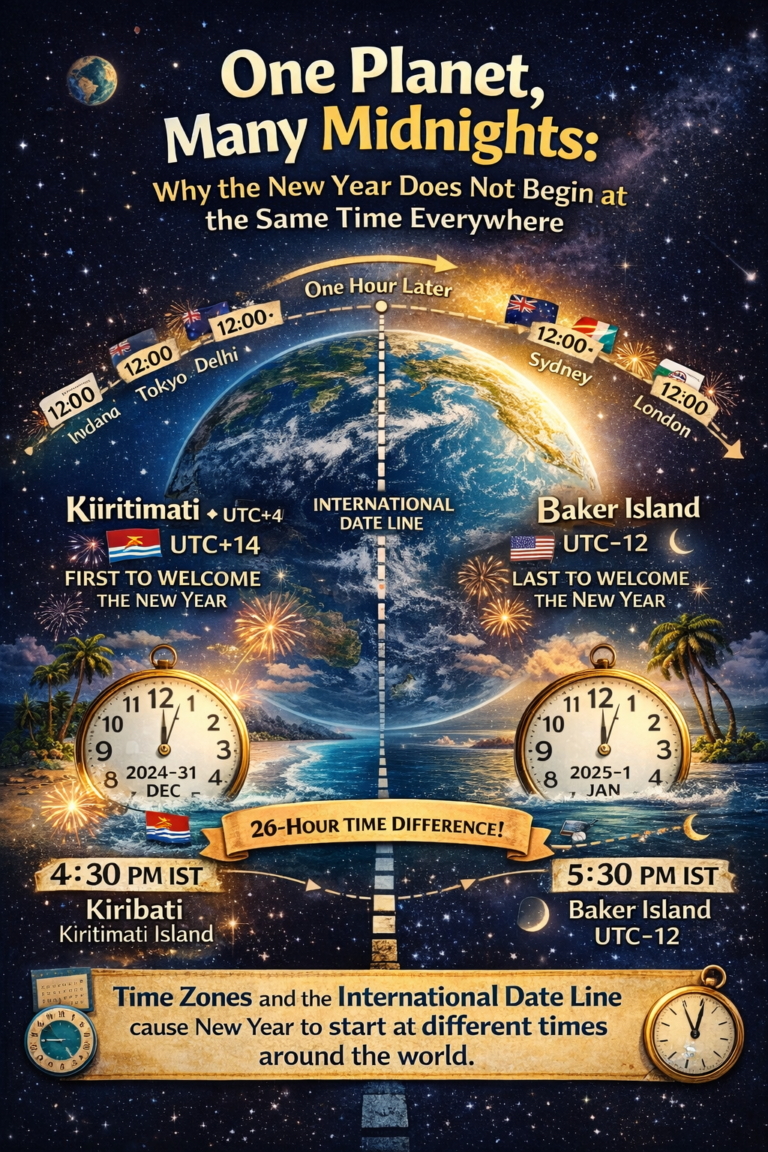
One Planet Many Midnights: Every year, as December turns into January, the world welcomes the New Year with joy, hope, and celebration. Fireworks light up the sky, clocks strike midnight, and people greet one another with wishes for happiness and success. Yet, despite sharing the same planet, humanity does not step into the New Year at the same moment. While one country is already celebrating January 1, another is still counting down the final hours of December 31. This fascinating difference exists because Earth is divided into multiple time zones and governed by an invisible but powerful boundary known as the International Date Line.
Understanding Time Zones: A Global Necessity
The Earth rotates on its axis once approximately every 24 hours. This rotation causes day and night, as different parts of the planet face the Sun at different times. If the entire world followed a single clock, daily life would become chaotic—noon could occur in the middle of the night, and sunrise might happen during office hours.
To avoid such confusion, the world is divided into time zones. There are roughly 24 major time zones, each differing by about one hour. The reference point for all these zones is Coordinated Universal Time (UTC), formerly known as Greenwich Mean Time (GMT), which is based on the Prime Meridian passing through Greenwich, England.
Each country or region sets its local time based on its position east or west of this prime reference. As a result, time gradually changes as one travels across the globe.
The International Date Line: Where the Date Changes
While time zones manage hours, the International Date Line controls the calendar date. This imaginary line runs mostly along the 180-degree longitude through the Pacific Ocean, carefully avoiding populated areas to prevent confusion. When someone crosses this line, the date changes by one full day—either forward or backward—depending on the direction of travel.
This date line plays a crucial role in determining when a new day, month, or year begins. Because of it, the New Year does not arrive everywhere simultaneously but instead moves step by step across the globe.
The First Place to Welcome the New Year: Kiritimati Island, Kiribati
The honor of welcoming the New Year first goes to the island nation of Kiribati, located in the Pacific Ocean. More specifically, it is Kiritimati Island (also known as Christmas Island) that experiences the first sunrise of January 1.
Kiritimati lies in the UTC +14 time zone, the most advanced time zone on Earth. This means it is 14 hours ahead of UTC and significantly ahead of most countries. Because of this, the New Year begins here before anywhere else on the planet.
According to Indian Standard Time (IST), the New Year starts on Kiritimati Island at approximately 4:30 PM on December 31. At that moment, much of the world—including India, Europe, and the Americas—is still preparing for the evening of the last day of the old year.
Kiribati deliberately adopted this advanced time zone in the 1990s, uniting its islands under the same calendar day and gaining global recognition as the first place to celebrate the New Year. This decision has also boosted tourism and international interest in the country.
A Moving Celebration: How the New Year Travels Across the World
After beginning in Kiritimati, the New Year slowly moves westward across the planet. From the Pacific Islands, it reaches New Zealand and eastern Australia, then spreads through East Asia, Southeast Asia, and South Asia—including India.
From there, the New Year continues its journey through the Middle East, Africa, and Europe, before finally reaching North and South America. Each region celebrates midnight according to its local time, creating a continuous, rolling wave of celebrations that lasts more than a full day.
This gradual progression highlights how interconnected yet diverse the world is—millions of people welcoming the same moment, but at different hours.
The Last Place to Enter the New Year: Baker Island
At the opposite end of the time spectrum lies Baker Island, a tiny, uninhabited island in the Pacific Ocean. It is located in the UTC −12 time zone, the most delayed time zone on Earth.
Because of this, Baker Island is the last place to experience the New Year. According to Indian Standard Time, the New Year arrives here at around 5:30 PM on January 1. By then, Kiritimati has already been living in the New Year for nearly 26 hours.
Although no one lives on Baker Island, its position is symbolically important. It marks the final point on Earth where the old year officially ends.
Why Is the Time Difference 26 Hours?
Most people think of a day as 24 hours long, so a 26-hour difference may seem puzzling. However, when comparing the most advanced time zone (UTC +14) with the most delayed one (UTC −12), the total difference adds up to 26 hours.
This extended range exists to accommodate geographical realities and political decisions, allowing countries to maintain practical local times. It is this difference that causes the New Year to unfold gradually rather than instantly across the world.
One New Year, Many Celebrations
Although the timing differs, the spirit of the New Year remains universal. Some countries celebrate with grand fireworks and street festivals, others with religious prayers, family gatherings, or quiet reflection. Cultures, traditions, and customs may vary, but the underlying message is the same—a farewell to the past and a hopeful step toward the future.
This staggered arrival of the New Year reminds us that time is both a scientific measurement and a human-made system designed to bring order to our lives.
The fact that the New Year does not begin at the same moment everywhere on Earth is not a mystery, but a result of Earth’s rotation, time zones, and the International Date Line. These systems allow the world to function smoothly while respecting geographical realities.
As the New Year travels from Kiritimati to Baker Island, it symbolically connects the entire planet in a shared celebration—one that unfolds hour by hour, region by region. Though separated by time, humanity is united by the same hope: that the coming year will bring peace, progress, and new beginnings for all.
Read More: One Planet, Many Midnights: Why the New Year Does Not Begin at the Same Time Everywhere
[…] Read More: One Planet, Many Midnights: Why the New Year Does Not Begin at the Same Time Everywhere […]