
“One Village, One AI Ma”: Antyodaya Digital Mission Brings Technology, Healthcare, Education and New Opportunities to Rural Communities
In an era when smartphones, artificial intelligence and digital platforms are transforming the way people access information and services, a significant gap still remains between those who can easily use technology and those who are left behind by it. For millions of people living in villages and remote communities, accessing quality healthcare, education, employment information, government-linked services and wider markets can still involve considerable distance, cost and technological barriers.
Addressing this challenge through a human-centred approach, the Antyodaya Digital Mission is emerging with a vision to take digital opportunities directly to rural communities. Rather than expecting villagers to navigate increasingly complicated digital systems on their own, the initiative seeks to create a local support network in which technology is brought closer to people through trained representatives.
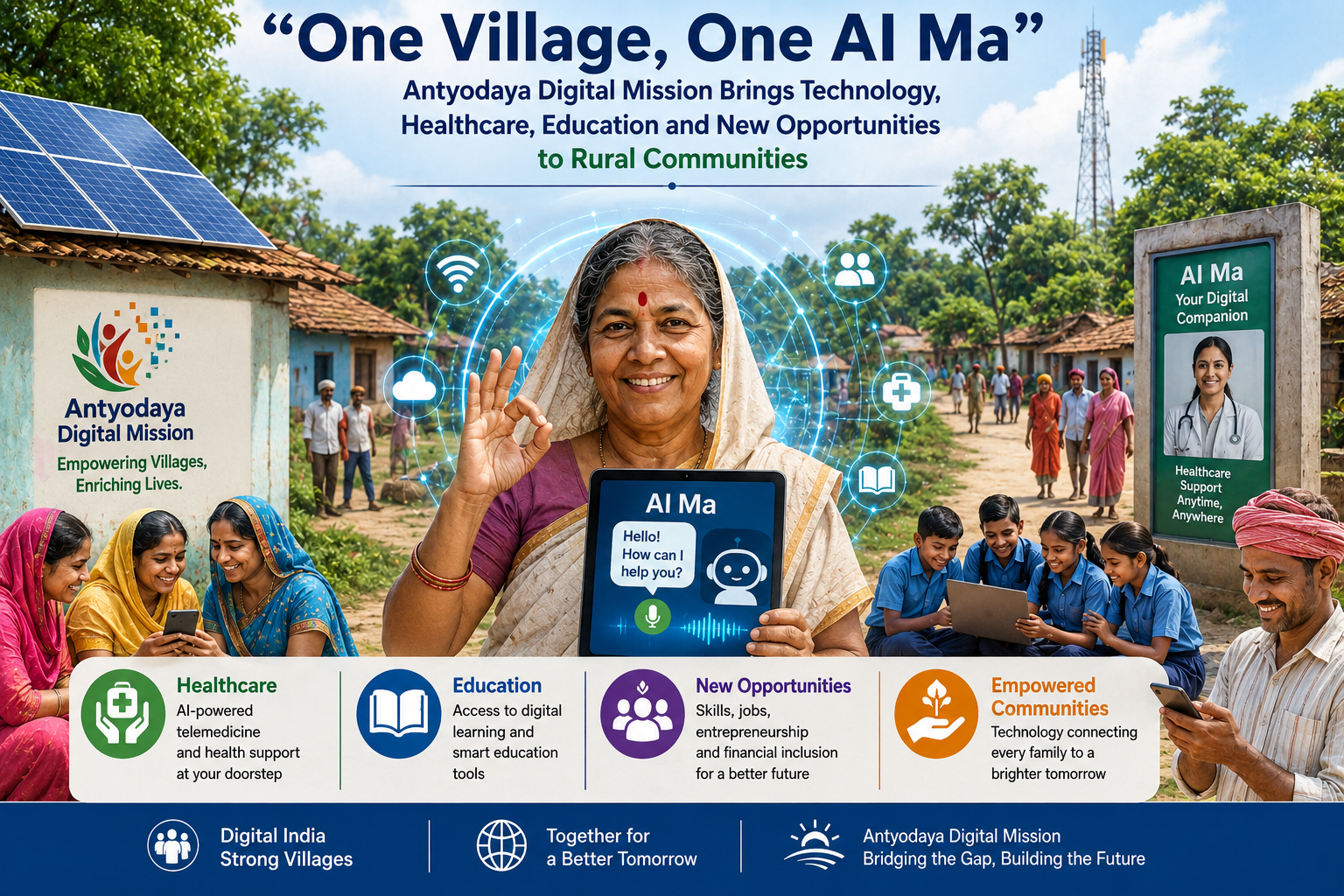
At the centre of this model is the concept of the “AI Ma”—a trained person from a village who can serve as a familiar local point of contact for digital services. The idea combines modern technology with something equally important: human trust.
The broader mission is designed to create opportunities across healthcare, education, tourism, sports, culture, skill development, employment and entrepreneurship, with the objective of building a more inclusive rural digital ecosystem.
A Different Approach to Digital Transformation
Digital transformation is often discussed in terms of internet connectivity, smartphones, artificial intelligence and online platforms. However, access to technology does not automatically mean that every person can benefit from it.
For a villager who is unfamiliar with online procedures, a digital service may appear complicated even when the underlying technology is simple. Language barriers, lack of confidence, limited digital literacy and uncertainty about online processes can prevent people from using services that are technically available to them.
The Antyodaya Digital Mission is built around a different philosophy.
Its central idea is that technology should travel towards people instead of forcing people to travel towards technology.
Under the proposed model, local representatives will be trained to help residents access digital opportunities from within their own communities. This approach can potentially reduce the psychological and practical barriers associated with digital services.
A familiar person who understands the local community can become the bridge between a sophisticated digital platform and an ordinary household.
The Institutions Behind the Initiative
The Antyodaya Digital Mission is operated and owned by the Itibachak Barta Foundation. Positive Barta serves as the brand associated with the initiative, while Ekdunia functions as its digital platform.
The mission receives financial support from Swadhin Charitable Trust. Academic collaboration is being provided by Santiniketan Medical College & Hospital, Bolpur, and Tripura Santiniketan Medical College & Hospital, Agartala.
The involvement of organisations from different fields reflects the broader character of the mission. Rather than focusing on a single service, the initiative aims to connect several dimensions of community development through digital technology.
The “AI Ma” Concept: Technology with a Human Face
The term “AI Ma” represents one of the most distinctive aspects of the initiative.
The concept is based on training one person from every village to function as a local digital representative. The AI Ma would not simply be a technology operator. The role is envisioned as a community-facing support position where people can seek assistance in accessing a variety of digital services.
For many villagers, the AI Ma could become the first point of contact when they want to explore a digital service.
A family might approach the local representative for assistance with telemedicine. A student could seek information about an online learning opportunity. A young person might look for skill-development or employment options. A local entrepreneur could receive support in connecting products with digital marketplaces.
In this way, one trained person could potentially help connect an entire community with a wide range of opportunities.
The strength of the model lies in combining digital capability with local familiarity.
Seven Pillars of the Antyodaya Digital Mission
The mission is structured around seven major areas, each addressing a different aspect of rural development.
1. Digital Hospital: Making Healthcare More Accessible
Healthcare is one of the most important areas where distance can create serious difficulties for rural populations.
People living in remote villages may have to travel significant distances even for consultations that could potentially be supported through digital platforms. The Digital Hospital initiative seeks to reduce such barriers by using technology to bring healthcare-related assistance closer to communities.
The proposed services include affordable OPD consultations, telemedicine and digital healthcare support. Prescription-related assistance through WhatsApp is also part of the planned service model.
The objective is not simply to introduce another digital platform, but to provide local assistance so that people can actually use digital healthcare services with greater confidence.
2. Digital Education: Opening Doors for Rural Students
Talent exists everywhere, but opportunities are not always distributed equally.
Students living in rural areas may face limitations in accessing specialised educational resources, online learning programmes, expert guidance and information about further studies.
Through its Digital Education initiative, the Antyodaya Digital Mission aims to create technology-enabled learning opportunities ranging from KG to PG.
The idea is to help rural students access educational resources and opportunities without making geographical location a permanent barrier to learning.
A digitally connected village could potentially give students access to knowledge and educational possibilities that were previously concentrated in larger towns and cities.
3. Digital Tourism: Showcasing Rural Heritage
India’s villages and smaller towns possess enormous cultural, historical and natural wealth. Yet many destinations remain relatively unknown because they lack organised digital visibility.
The Digital Tourism component seeks to use technology to promote local attractions, heritage destinations and tourism-related services.
Greater digital visibility could help local communities participate more actively in tourism. Homestays, local guides, handicrafts, traditional food, cultural experiences and other community-based services could potentially find wider audiences.
This could create an ecosystem in which tourism benefits not only visitors but also local residents.
4. Digital Sports: Finding Talent Beyond the Cities
India’s sporting talent is not limited to metropolitan centres. Rural communities have produced athletes in numerous disciplines, but many young players struggle to access proper training, information and opportunities.
The Digital Sports initiative aims to identify talented athletes from rural communities and connect them with training opportunities and wider sporting platforms.
Technology can play an important role in sharing information about competitions, coaching programmes and development opportunities.
The larger goal is to ensure that geography does not become the deciding factor in determining whether a talented young athlete gets an opportunity to progress.
5. Digital Culture: Preserving the Identity of Communities
Local culture is an important part of India’s identity. Folk music, traditional dance, handicrafts, storytelling, regional art and community traditions are often preserved through generations.
However, rapid social and economic changes can place traditional cultural practices at risk of disappearing.
The Digital Culture initiative seeks to document, preserve and promote local artistic and cultural expressions through digital platforms.
Digitisation could provide rural artists and cultural practitioners with an opportunity to reach audiences far beyond their immediate communities. A folk artist who previously performed only before a local audience could potentially showcase their work to viewers across India and internationally.
In this sense, technology could become not only a tool for modernisation but also a mechanism for cultural preservation.
6. Digital Skills and Employment: Preparing Rural Youth for a Changing Economy
Employment opportunities are increasingly influenced by digital skills. From online services and remote work to digital entrepreneurship, new forms of livelihood are emerging.
The Antyodaya Digital Mission aims to help young people and other community members connect with skill-development opportunities and potential sources of employment and income.
For rural youth, information itself can be a major resource. Knowing where to find training, how to apply for opportunities and which skills are in demand can make an important difference.
By connecting communities with digital skill and employment opportunities, the initiative hopes to contribute to greater economic participation.
7. Digital Haat: Taking Local Products to Larger Markets
Rural communities produce a wide variety of agricultural products, handicrafts, handmade goods and other locally developed products. Yet many small producers have limited access to markets beyond their immediate surroundings.
The Digital Haat and Entrepreneurship Development initiative aims to connect these products and small businesses with digital marketplaces.
A local entrepreneur could potentially use digital platforms to reach customers outside the village or district. Farmers, artisans, craftspeople and small business owners could gain greater visibility and explore new markets.
The broader objective is to support rural entrepreneurship and encourage communities to become more economically self-reliant.
Ekdunia Digital Hospital: Bringing Healthcare Support Closer to Villages
Among the major initiatives under the Antyodaya Digital Mission is Ekdunia Digital Hospital, which seeks to combine digital technology with human assistance.
According to the information provided for the initiative, the formal launch of Ekdunia Digital Hospital is scheduled for Thursday, 17 September 2026.
The proposed model would enable trained AI Mas to help villagers access essential digital healthcare services from their own communities.
For rural residents, this could mean easier access to digital health support without having to travel long distances simply to initiate or manage certain digital healthcare processes.
Seven Core Healthcare Services
The proposed Ekdunia Digital Hospital model includes seven major categories of assistance.
Telemedicine Consultation: Helping residents connect with doctors through digital consultation platforms.
Medicine Delivery Assistance: Supporting the process of arranging the collection and delivery of prescribed medicines.
Laboratory Sample Collection and Coordination: Assisting with sample collection and coordinating with diagnostic services.
ABHA ID Creation: Helping citizens create their digital health identity through the Ayushman Bharat Health Account system.
Ayushman Bharat Assistance: Supporting eligible citizens in connecting with relevant government healthcare schemes and benefits.
Digital Health Record Management: Helping residents maintain important health information and medical documents in digital form.
Follow-up and Emergency Referral Support: Assisting patients with follow-up processes and facilitating timely referral to higher-level healthcare centres whenever required.
Together, these services are intended to create a more connected healthcare experience for rural communities.
Why the Human Element Matters
The rapid development of artificial intelligence and digital platforms has generated enormous possibilities. Yet technology alone cannot solve every problem.
A digital system may be technically efficient, but people still need guidance, reassurance and human interaction.
This is particularly relevant in communities where digital literacy levels vary significantly.
The AI Ma model attempts to address this challenge by placing a trusted local person between technology and the end user.
Instead of presenting technology as something complicated and distant, the AI Ma can potentially explain the process in a familiar manner and help residents take the necessary steps.
The concept therefore represents a combination of artificial intelligence, digital infrastructure and community-level human support.
A Digital Ecosystem Rather Than a Single Service
Another significant feature of the Antyodaya Digital Mission is its integrated approach.
Healthcare, education, employment, skills, tourism, sports, culture and entrepreneurship are often treated as separate sectors. But in real life, these areas are interconnected.
A student needs education to develop skills. Skills can lead to employment. Employment can contribute to household income. Entrepreneurship can create local jobs. Tourism can support artisans and local businesses. Digital healthcare can reduce the burden of travelling long distances for certain services.
By bringing these areas together within a common digital ecosystem, the mission aims to create a broader network of opportunity.
The Road Towards Inclusive Digital Development
The success of digital development should not be measured only by the sophistication of technology.
A truly inclusive digital transformation must also ask a more fundamental question: Who is benefiting from the technology?
If advanced digital services remain concentrated among people who already possess strong digital literacy, then the digital divide may continue despite technological progress.
The Antyodaya Digital Mission seeks to approach the problem from the opposite direction—starting with the needs of communities and then using technology to address those needs.
Its vision is to ensure that people living in remote locations are not excluded from the opportunities created by digital transformation.
A New Opportunity for Rural Communities
The proposed model has the potential to create a new form of digital participation at the village level.
A single AI Ma could become a connection point for multiple services. Through one local representative, a household could potentially discover healthcare options, a student could explore education, a young person could search for employment opportunities and an entrepreneur could explore digital markets.
Such a system could make the village itself an important node in the digital economy.
Instead of rural communities being passive consumers of technology developed elsewhere, they could become active participants in a larger digital ecosystem.
“One Village, One AI Ma, Countless Possibilities”
The phrase “One Village, One AI Ma, Countless Possibilities” captures the social ambition behind the initiative.
At its heart is a simple belief: technology becomes truly meaningful when it improves people’s everyday lives.
The AI Ma model seeks to make technology more approachable by combining digital tools with personal assistance. The goal is to ensure that the benefits of digital development are not restricted by geography, education or familiarity with technology.
From healthcare and education to employment, culture and entrepreneurship, the initiative envisions a future in which rural communities can access a much wider range of opportunities from closer to home.
Technology with a Purpose
The Antyodaya Digital Mission represents a broader conversation about what technology should ultimately achieve.
The future of digital development cannot be defined only by artificial intelligence, faster networks or increasingly sophisticated platforms. It must also be measured by inclusion—by whether technology reaches people who need it most.
If the mission’s model succeeds in connecting rural communities with essential services and economic opportunities, the impact could extend beyond digital access. It could influence education, healthcare awareness, employment, entrepreneurship, cultural preservation and local economic activity.
The underlying philosophy remains straightforward: people should not have to chase technology; technology should come closer to people.
With the planned “AI Ma” network and the seven-pillar approach covering healthcare, education, tourism, sports, culture, skills and entrepreneurship, the Antyodaya Digital Mission is seeking to create a distinctly human-centred pathway towards rural digital empowerment.
The journey ahead will depend on effective training, reliable digital infrastructure, responsible use of technology, community participation and sustainable implementation. But the central idea is clear.
A village should not be defined by how far it is from a city. It should be defined by the opportunities available to its people.
And if one trained local representative can help connect an entire community to the digital world, then the smallest village can become the starting point for countless new possibilities.
One village. One AI Ma. Countless possibilities.
Read More: Vitamin K: The Unsung Nutrient That Protects Blood Clotting, Bones and Overall Health!!!





[…] Read More: AI Ma: Antyodaya Digital Mission Brings Technology!!! […]