

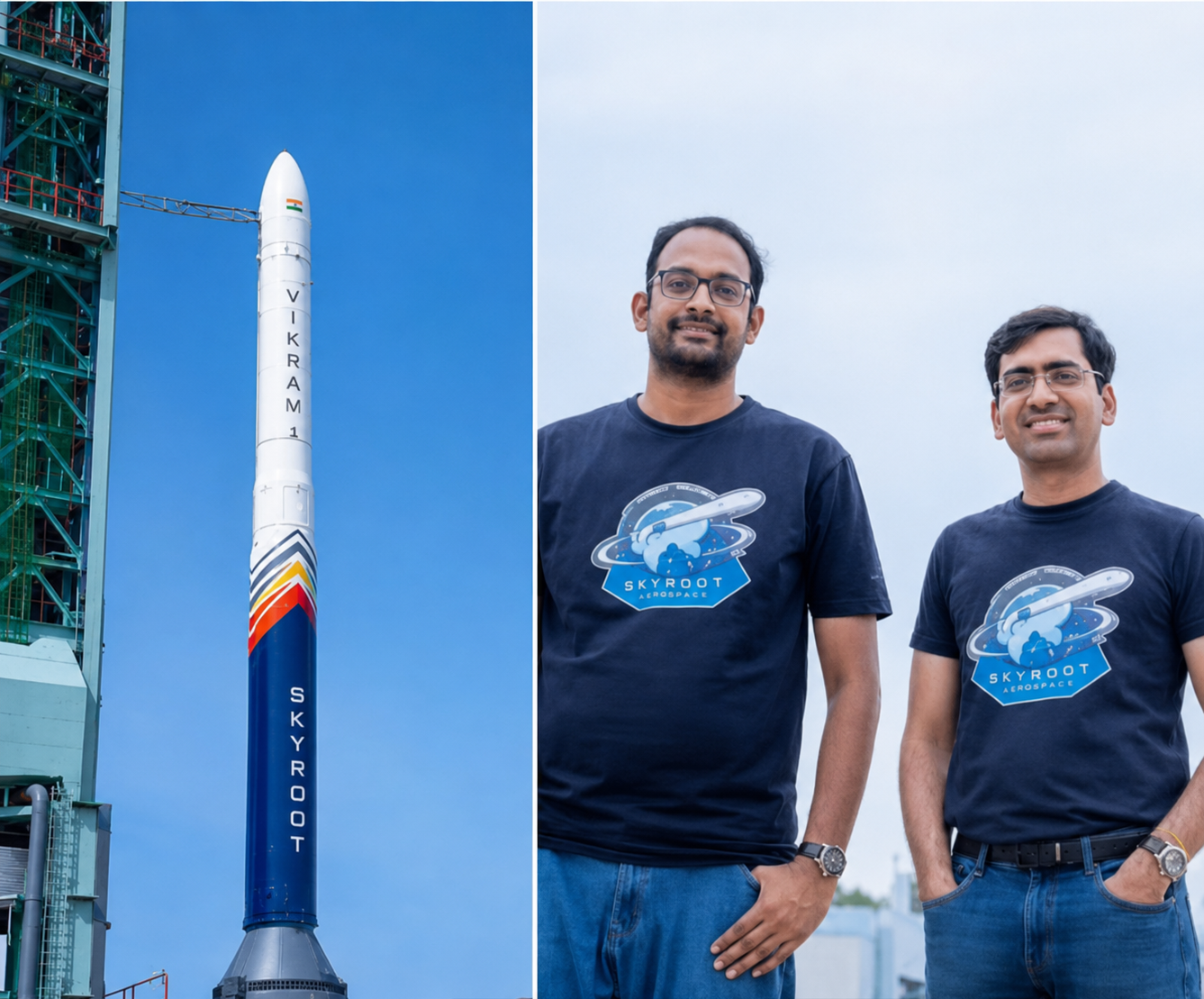
India Opens a New Era in Space: Vikram-1’s Historic Success Makes Private Spaceflight a National Reality
India scripted a defining chapter in its scientific and technological history on Saturday as Vikram-1, the nation’s first privately developed orbital launch vehicle, successfully lifted off from the Satish Dhawan Space Centre (SDSC), Sriharikota, and placed multiple technology demonstration payloads into Low Earth Orbit (LEO). The landmark mission, christened “Mission Aagaman”, represents far more than a successful rocket launch—it marks the arrival of India’s private space industry as a serious force in the global commercial launch market.
Developed by Hyderabad-based Skyroot Aerospace, Vikram-1 has become the first orbital-class launch vehicle designed, engineered, manufactured, integrated, and launched by an Indian private company. The successful mission is widely regarded as one of the most significant milestones in India’s space journey since the country’s first successful satellite launch in 1980.
With this achievement, India has demonstrated that its rapidly growing private space ecosystem is capable of complementing the country’s globally respected government-led space programme. The launch also reflects the transformation of India’s space sector following policy reforms that encouraged private participation, innovation, and entrepreneurship.
A Historic Morning at Sriharikota
The launch was originally scheduled for 11:30 a.m., but engineers initiated a planned hold approximately five minutes before liftoff after the automated launch sequence detected a checkpoint requiring further verification.
Rather than rushing the mission, engineers carefully reviewed every onboard system. Following detailed checks, the Automated Launch Sequence was restarted, and a revised launch time of 12:05 p.m. was announced.
At precisely 12:05 p.m., Vikram-1 roared into the skies from the Satish Dhawan Space Centre, carrying the hopes of an emerging private space industry along with several technology demonstration payloads.
As the vehicle climbed steadily through the atmosphere, every stage performed according to plan. Approximately 15 minutes and 46 seconds after liftoff, the rocket successfully injected its payloads into a 450-kilometre Low Earth Orbit with an inclination of approximately 60 degrees, meeting all primary mission objectives.
Cheers erupted inside Skyroot Aerospace’s Mission Control Centre as engineers celebrated years of research, testing, and relentless effort culminating in a flawless maiden orbital mission.
Mission Aagaman: Symbolising the Arrival of a New India
The mission was appropriately named “Aagaman,” meaning “Arrival.”
The title reflects the arrival of India’s private launch capability on the global stage. For decades, India’s remarkable achievements in space exploration have largely been driven by the Indian Space Research Organisation (ISRO). While ISRO continues to remain the backbone of India’s space programme, Mission Aagaman signals that the private sector is now ready to play a major role alongside it.
The mission demonstrates that Indian startups are capable of designing sophisticated launch vehicles, manufacturing advanced propulsion systems, integrating cutting-edge technologies, and delivering satellites into orbit.
Industry experts believe this marks the beginning of a new era where government institutions and private enterprises together will shape India’s future in space.
Skyroot Aerospace: A Startup That Dreamed Big
Founded by former ISRO scientists, Skyroot Aerospace was established with a vision of making space launches faster, affordable, and more accessible.
Within only a few years, the company achieved several technological breakthroughs.
Its first major success came in November 2022, when Vikram-S, India’s first privately built rocket to reach space, completed a successful suborbital mission.
Mission Aagaman represents the company’s second major launch campaign—but its first attempt to place payloads into orbit.
Unlike suborbital rockets that briefly enter space before returning, orbital launch vehicles require far greater engineering precision, powerful propulsion systems, and accurate navigation to achieve orbital velocity.
The successful completion of Mission Aagaman proves that Skyroot Aerospace has mastered one of the most demanding challenges in aerospace engineering.
Why Vikram-1 Is Special
Vikram-1 is among the most technologically advanced launch vehicles developed by an Indian private company.
Standing 22 metres tall with a diameter of 1.7 metres, the vehicle has been designed specifically for launching small satellites weighing up to 350 kilograms into Low Earth Orbit.
Its architecture combines modern lightweight materials with advanced propulsion technologies that reduce manufacturing time while improving launch efficiency.
Major technological highlights include:
- All-carbon composite rocket structure
- Three solid rocket stages
- Liquid-powered Orbital Adjustment Module
- High-thrust indigenous propulsion systems
- Fully 3D-printed rocket engines
- Rapid manufacturing capability
- High launch frequency design
- Advanced pneumatic stage separation system
These innovations make Vikram-1 both economical and highly competitive in the rapidly expanding global small satellite launch market.
Built with Next-Generation Engineering
One of the most remarkable aspects of Vikram-1 is its extensive use of carbon-composite materials.
Traditional metallic rocket structures are generally heavier and require more manufacturing time.
By adopting carbon composites throughout the primary structure, Skyroot Aerospace has significantly reduced the rocket’s weight while maintaining exceptional structural strength.
Another breakthrough is the use of 100 percent 3D-printed engines, allowing faster production, reduced manufacturing costs, and greater design flexibility.
Such technologies represent the future of launch vehicle manufacturing worldwide.
Mission Objectives Successfully Achieved
Mission Aagaman was designed primarily as a technology demonstration flight.
Its major objectives included:
- Safe ignition
- Successful liftoff
- Tower clearance
- Stage separations
- Vehicle stability
- Propulsion system validation
- Navigation performance
- Orbital insertion
- Payload deployment
- Collection of in-flight engineering data
According to Skyroot Aerospace, every major mission objective was successfully achieved.
The engineering data gathered throughout the ascent will now be carefully analysed to further improve future launch vehicles.
Payloads Carried by Vikram-1
Although primarily a demonstration mission, Vikram-1 carried multiple payloads representing technological innovation, scientific collaboration, and artistic creativity.
Among the payloads were:
Grahaa Space
Solaras Satellite
Cosmoserve Space
Embrace
Skyroot Aerospace
SCOPE Satellite
Germany’s DCubed
uD3PP
mD3RN
Cosmos Diamonds
Cosmic Bloom artwork
Ajay Kumar Mattewada
Micro Art Tribute
In addition, hundreds of postcards from citizens across the world were launched into orbit, including a handwritten postcard from Prime Minister Narendra Modi.
India’s Entry into an Exclusive Global Club
The successful orbital launch has elevated India’s private aerospace sector into an elite international category.
Only a handful of nations possess private companies capable of independently designing, building, and launching orbital rockets.
Mission Aagaman demonstrates that India’s growing startup ecosystem is now capable of competing in one of the world’s most technologically demanding industries.
It also reflects the maturity of India’s manufacturing capabilities, engineering talent, and policy reforms supporting private innovation.
A Carefully Managed Launch
The temporary launch hold shortly before liftoff highlighted the mission team’s emphasis on safety and precision.
During the final countdown, onboard computers continuously monitored hundreds of parameters.
When one verification checkpoint required additional confirmation, the launch sequence automatically paused.
Rather than considering it a setback, engineers described the pause as part of standard launch procedures designed to maximise mission safety.
Once all systems were cleared, the launch proceeded flawlessly.
The successful handling of the situation demonstrated the maturity of Skyroot Aerospace’s operational procedures.
A Journey Inspired by Vikram Sarabhai
The rocket has been named after Dr. Vikram Sarabhai, widely recognised as the father of India’s space programme.
His vision transformed India from a developing nation with limited resources into one capable of conducting world-class space missions.
Naming India’s first private orbital rocket after him symbolises the continuation of that legacy into a new generation driven by entrepreneurship and innovation.
A Proud Moment for India’s Space Ecosystem
Following the successful launch, congratulations poured in from across the country.
Prime Minister Narendra Modi spoke with Skyroot Aerospace Co-founder and CEO Pawan Kumar Chandana, describing the launch as a defining milestone in India’s space journey.
The Prime Minister emphasised that increasing private participation is opening entirely new frontiers for innovation and inspiring young Indians to dream bigger.
He noted that achievements like Mission Aagaman strengthen India’s vision of becoming a global leader in advanced technology.
Industry Leaders Celebrate the Achievement
IN-SPACe Chairman Pawan Goenka described the mission as an “India moment.”
He remarked that very few nations possess independent access to space, and now an Indian private company has joined that exclusive community.
According to him, the achievement reflects years of dedication from more than a thousand professionals and nearly four hundred suppliers working together to transform an ambitious vision into reality.
Remembering India’s First Orbital Success
Mission Aagaman carries deep historical significance because it took place 46 years after India’s first successful Satellite Launch Vehicle (SLV-3) mission.
On 18 July 1980, India became the sixth spacefaring nation after successfully placing the Rohini satellite into orbit from the same launch centre at Sriharikota.
Exactly forty-six years later, another milestone has been added to the nation’s space history—this time by the private sector.
The coincidence of dates has made the achievement even more symbolic.Economic Opportunities Ahead
The global small satellite industry is growing rapidly.
Governments, universities, research institutions, telecommunications companies, and commercial enterprises increasingly require affordable launch services for satellites used in:
- Earth observation
- Internet connectivity
- Climate monitoring
- Navigation
- Agriculture
- Defence
- Disaster management
- Scientific research
Industry analysts estimate that thousands of small satellites will require launch services over the next decade.
With Vikram-1, India is positioning itself as a competitive provider in this expanding international market.
Boost for India’s Startup Ecosystem
Mission Aagaman represents far more than a technological success.
It is also a powerful demonstration of India’s thriving startup ecosystem.
The mission showcases what becomes possible when policy support, scientific talent, venture capital, manufacturing capability, and entrepreneurial vision come together.
For young innovators across India, Vikram-1 sends a clear message: world-class aerospace technology can be designed and built within the country.
What Comes Next?
Skyroot Aerospace has announced that Mission Aagaman is only the beginning.
The company intends to analyse all flight data before conducting additional demonstration missions.
Following successful validation, Vikram-1 is expected to enter regular commercial service, offering launch opportunities for domestic and international satellite customers.
The long-term objective is to establish India as a preferred destination for affordable, reliable, and high-frequency satellite launches.
A New Chapter for Indian Space
India’s remarkable space journey began decades ago with modest resources and extraordinary determination.
From launching the Rohini satellite to sending spacecraft to the Moon and Mars, the nation has consistently expanded the boundaries of its scientific capability.
Mission Aagaman now represents the next evolution of that journey.
It shows that India’s future in space will not be driven solely by government agencies but also by innovative private enterprises capable of competing globally.
The successful launch of Vikram-1 is much more than the maiden flight of a new rocket. It is the beginning of a transformative era in which Indian private industry joins the nation’s space ambitions with confidence and capability.
Mission Aagaman has demonstrated the strength of Indian engineering, the maturity of its startup ecosystem, and the effectiveness of reforms that opened the space sector to private participation.
As Vikram-1 completed its journey into orbit, it carried not only scientific payloads and commemorative postcards but also the aspirations of a nation determined to lead the next generation of space innovation.
For India, July 18, 2026, will be remembered as the day when private enterprise truly reached orbit—and when a new chapter in the country’s space story began.
Read More : World AIDS Day – is an international day