

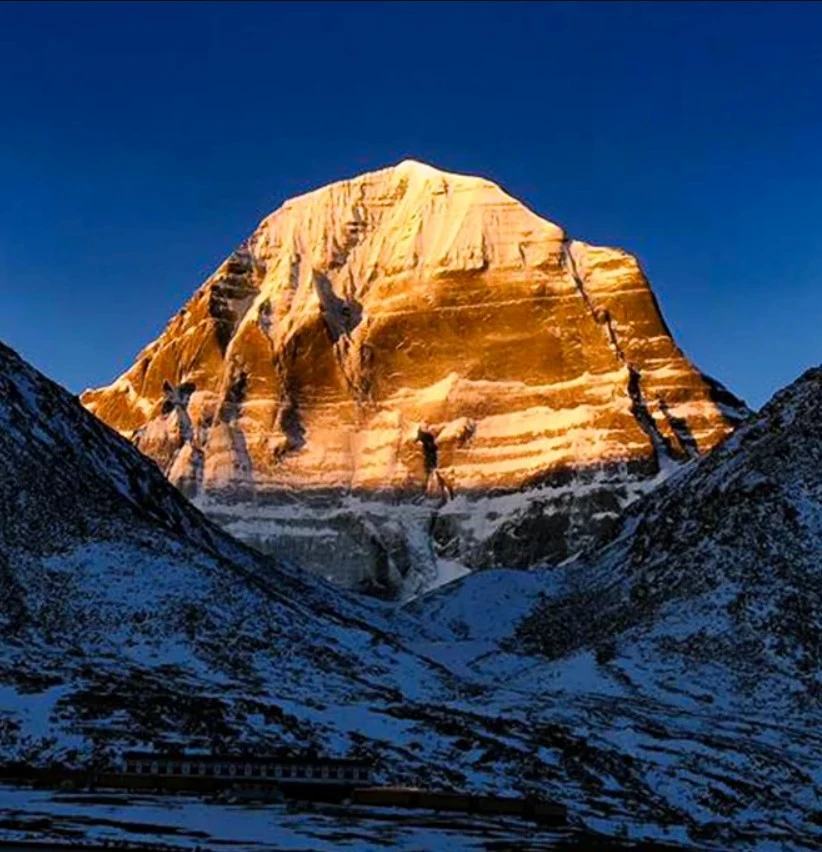
Kailash: The Sacred Summit That Human Feet Have Never Conquered
Everest has been climbed, K2 has been conquered, but one sacred Himalayan peak remains untouched by human ascent
For more than a century, modern mountaineering has transformed the relationship between human beings and the world’s highest mountains. Climbers have stood on the summit of Mount Everest, crossed the formidable slopes of K2, challenged Annapurna and ventured into some of the most dangerous terrain on Earth.
Technology has advanced. Equipment has become lighter and stronger. Weather forecasting has improved. High-altitude medicine has developed dramatically. Routes that once appeared impossible have been explored and climbed.
Yet, in the remote western part of Tibet, one mountain continues to occupy a unique position in the history of exploration.
That mountain is Mount Kailash.
Rising to approximately 6,638 metres above sea level, Kailash is considerably lower than Mount Everest. It is not generally regarded by professional mountaineers as the world’s most technically difficult mountain. Yet its summit remains without a reliably documented, recognised successful ascent.
The reason is not simply the height of the mountain or the challenges presented by snow and ice.
Kailash is different because it is sacred.
For Hindus, Buddhists, Jains and followers of the Tibetan Bön tradition, the mountain carries profound religious significance. For centuries, pilgrims have travelled towards it not to plant a flag on its summit but to walk around it in a ritual pilgrimage known as the Kora or Parikrama.
Modern climbing on the summit is not permitted.
As a result, Kailash presents an extraordinary contrast with the rest of the world’s great mountains. While many famous peaks are celebrated because human beings reached their highest points, Kailash is revered precisely because its summit has remained untouched.
It is a mountain where the idea of conquest gives way to the idea of respect.
A Mountain in the High Tibetan Landscape
Mount Kailash stands in the western part of Tibet and forms part of the Gangdise, or Transhimalaya, mountain system.
The surrounding landscape is among the most dramatic on the Tibetan Plateau. Vast high-altitude plains, barren mountains, glaciers, snowfields and extremely thin air define the environment.
Near Kailash lie two famous lakes—Lake Manasarovar and Rakshastal. Together with the surrounding mountains and plateau, they form one of Asia’s most remarkable natural and religious landscapes.
The region also has immense geographical significance.
The broader Tibetan Plateau contains some of the most important headwater regions in Asia. The Indus, Sutlej, Karnali and Brahmaputra river systems are geographically connected with this wider high-altitude environment.
Thus, Kailash has several identities at once.
To a geographer, it is a prominent mountain in the Transhimalaya.
To a student of hydrology, it stands within a region associated with major Asian river systems.
To a traveller, it is one of the world’s most extraordinary landscapes.
To a pilgrim, it is sacred ground.
And to mountaineering history, it remains an exceptional summit that has never acquired the conventional story of a recognised first ascent.
The Pyramid-Like Peak
One of the most striking characteristics of Kailash is its appearance.
The mountain has a distinctive, almost symmetrical pyramid-like form, with its upper slopes often covered in snow. From different viewpoints, the geometric appearance of the peak can be remarkably dramatic.
This unusual shape has contributed greatly to the mountain’s fame.
Photographs of Kailash frequently show a sharply defined summit rising above the surrounding Tibetan landscape. The contrast between the dark rock, white snow and vast open plateau gives the mountain an appearance that is unlike many other Himalayan peaks.
For generations, this visual character has also encouraged religious and cultural interpretations.
But the mountain does not need supernatural explanations to be extraordinary. Its location, geology, altitude, landscape and religious history already make it one of the most distinctive mountains on Earth.
Why Is Kailash Sacred?
Kailash’s greatest distinction is not its height.
It is its spiritual importance.
Hindu Tradition
In Hindu tradition, Mount Kailash is regarded as the abode of Lord Shiva. Numerous religious traditions, stories and devotional practices connect Shiva and Parvati with the sacred mountain.
For many Hindus, therefore, Kailash is not merely a geographical feature. It represents a sacred centre associated with divine presence, meditation and spiritual power.
Buddhist Tradition
Kailash also occupies an important position in Tibetan Buddhist traditions. The mountain is associated with religious narratives and sacred geography and is regarded as an important pilgrimage destination.
Jain Tradition
Jain traditions also connect the region with significant religious history and spiritual beliefs.
Bön Tradition
For followers of the ancient Tibetan Bön tradition, Kailash holds its own sacred significance.
The remarkable fact is that four distinct religious traditions regard the mountain as sacred, although their interpretations and rituals are not identical.
This shared reverence has played an important role in shaping the modern history of the mountain.
The Difference Between Kailash and Other Famous Peaks
The history of mountaineering is usually written around achievement.
Who reached the summit first?
Who climbed the mountain without supplementary oxygen?
Who discovered a new route?
Who completed the ascent in the shortest time?
For Everest, the names of Edmund Hillary and Tenzing Norgay are permanently associated with the first confirmed ascent.
For many other great mountains, the names of pioneering climbers are similarly recorded.
Kailash presents a completely different narrative.
There is no universally recognised first successful summit ascent.
Instead, its modern history revolves around exploration, proposed routes, attempted investigations, religious sensitivity and restrictions on climbing.
The distinction is important.
Kailash is not necessarily an example of a mountain that humans have been physically incapable of climbing. Rather, it is a mountain where the circumstances surrounding climbing are fundamentally different.
The question is not simply:
Can it be climbed?
The larger question is:
Should it be climbed?
For generations, religious communities have answered that question by treating the summit as sacred and leaving it untouched.
Early Mountaineering Interest
During the early twentieth century, as European explorers and mountaineers increasingly studied the remote Himalayan and Tibetan regions, Kailash attracted attention.
Mountaineers were interested in its structure and possible routes.
In 1926, British explorer Hugh Ruttledge visited the Kailash region and examined possible approaches to the mountain. At roughly the same period, Colonel R. C. Wilson also investigated the mountain from another direction and considered its potential climbing routes.
These investigations did not result in a recognised summit ascent.
Difficult snow conditions and the nature of the mountain made a serious climbing attempt complicated. More importantly, the religious significance of Kailash made the mountain unlike a normal mountaineering objective.
Exploration and observation were possible, but the idea of deliberately climbing the sacred summit raised a different set of questions.
Herbert Tichy and the Stories Surrounding Kailash
Austrian explorer Herbert Tichy visited the Kailash region in 1936.
Accounts associated with expeditions to Kailash have often included local religious traditions and legends.
One widely repeated belief suggests that only a person who is completely pure or free from sin could reach the summit.
Such claims belong to the realm of religious belief and folklore. They are not scientific explanations and there is no modern scientific evidence establishing such a condition.
Nevertheless, these stories reveal how differently Kailash has traditionally been viewed.
On an ordinary mountain, climbers discuss snow conditions, rock quality, avalanche danger and route difficulty.
At Kailash, those physical questions exist alongside questions of faith, reverence and cultural tradition.
That combination makes the mountain unique.
Reinhold Messner and the Decision Not to Climb
Few names in twentieth-century mountaineering carry as much weight as Reinhold Messner.
Messner is famous for becoming the first mountaineer to climb all fourteen of the world’s 8,000-metre peaks. His achievements fundamentally shaped modern high-altitude mountaineering.
His connection with Kailash therefore attracts particular attention.
Various mountaineering accounts have stated that during the 1980s Messner had an opportunity to climb Kailash. He did not take that opportunity.
The significance of the decision lies in the fact that Messner was not an inexperienced climber deterred simply by altitude.
He was one of the world’s most accomplished mountaineers.
His decision demonstrated that Kailash could not be understood merely as another climbing challenge.
Messner later visited the region and participated in the pilgrimage around the mountain.
His experience became part of the broader story of Kailash—a story in which even a legendary mountaineer could choose reverence over a summit attempt.
The Controversy of 2001
The year 2001 brought renewed international attention to the question of climbing Kailash.
Reports emerged that a Spanish expedition had received permission to climb the mountain.
The news generated strong reactions from different religious communities, for whom climbing the sacred summit was deeply objectionable.
The issue quickly became more than a mountaineering story.
It became a discussion about religious respect, cultural heritage and the limits of adventure tourism.
Chinese authorities subsequently rejected reports that climbing permission had been granted and maintained the position that climbing Kailash was not permitted.
The episode reinforced an important point:
Kailash’s status as an unclimbed mountain is connected not only to its physical geography but also to administrative restrictions and religious sensitivity.
You Can Visit Kailash—But You Cannot Climb Its Summit
Another common misunderstanding is that Kailash itself is completely inaccessible.
That is not the case.
Pilgrims have travelled to the Kailash region for generations. The mountain can be viewed and circumambulated.
What is restricted is the act of climbing the summit.
This distinction is central to understanding Kailash.
A pilgrimage to Everest Base Camp is not the same as climbing Everest.
Likewise, travelling around Kailash is not the same as attempting to reach its summit.
For pilgrims, the mountain does not need to be conquered.
It needs to be respected.
The Sacred Kora Around the Mountain
The most important physical activity associated with Kailash is the Kora, also known as Parikrama.
The circuit around the mountain is commonly described as roughly 52 kilometres, although exact measurements can vary according to the route and method of calculation.
For pilgrims, completing the Kora is a major religious undertaking.
The route passes through high-altitude terrain and includes one of its most demanding sections at Drolma La, a high pass at approximately 5,600 metres.
At such elevations, even walking becomes physically demanding.
The air contains considerably less oxygen than at sea level. Cold temperatures, strong winds, steep terrain and rapidly changing weather can make the journey challenging.
Many pilgrims complete the circuit on foot.
Others follow traditional practices involving repeated prostrations, covering only a small distance before bowing or lying down and continuing the journey.
For them, the physical hardship is part of the spiritual experience.
Why Is Drolma La Important?
Drolma La is regarded as one of the highest and most demanding points along the Kailash pilgrimage circuit.
Reaching the pass requires considerable physical effort.
The altitude alone presents a challenge. Travellers who have not properly acclimatised may experience symptoms associated with high-altitude illness.
This is why the Kailash pilgrimage should not be viewed simply as a sightseeing trip.
It takes place in a severe high-altitude environment.
Weather conditions can change rapidly, and the physical demands of the journey can vary considerably from one season to another.
Different Traditions, Different Directions
The religious diversity surrounding Kailash is also reflected in the direction of circumambulation.
Hindu and Buddhist pilgrims generally perform the Kora in a clockwise direction.
Jain and Bön traditions are associated with circumambulation in the opposite direction.
The difference reflects the distinct religious traditions connected with the mountain.
Yet despite these differences, the mountain itself remains the common centre of reverence.
Kailash therefore represents an unusual meeting point of different cultures and spiritual traditions.
Is Kailash the World’s Hardest Mountain?
The claim that Kailash is the world’s hardest mountain to climb is frequently repeated online.
However, it is not a technically precise description.
At approximately 6,638 metres, Kailash is significantly lower than Everest. There are numerous mountains around the world with much more severe technical climbing challenges.
Mountain difficulty depends on many factors.
Altitude is only one factor.
Other considerations include:
- steepness of the route;
- rock and ice conditions;
- avalanche danger;
- weather;
- technical climbing requirements;
- remoteness;
- rescue possibilities; and
- the availability of established routes.
Therefore, describing Kailash as the world’s most difficult mountain would be misleading.
Its uniqueness lies somewhere else.
The Real Reason Kailash Remains Unclimbed
The story becomes clearer when several factors are considered together.
First, Kailash is a high and environmentally demanding mountain.
Second, it possesses extraordinary religious significance.
Third, summit climbing is not permitted.
These factors combine to create its unusual status.
Modern mountaineering technology has made it possible for humans to reach many extremely difficult summits. Therefore, Kailash’s lack of a recognised summit ascent cannot simply be explained as a failure of human technology.
Human decisions matter.
Religious beliefs matter.
Government restrictions matter.
Cultural sensitivity matters.
And all of these factors have helped keep the summit untouched.
The Mountain That Does Not Need a Flag
For much of mountaineering history, placing a flag or reaching the highest point represented achievement.
Kailash challenges that idea.
Here, the absence of a human footprint on the summit is itself meaningful.
There is no universally recognised first climber whose name dominates the mountain’s modern history.
Instead, the mountain is associated with pilgrims walking around it.
The focus has shifted from conquest to reverence.
That is perhaps the most extraordinary feature of Kailash.
A Landscape Connected to Asia’s Great Rivers
The broader region around Kailash is also significant because of its relationship with major Asian river systems.
The Tibetan Plateau is often described as one of the world’s great water towers because numerous major rivers originate in or around this high-altitude region.
The Indus, Sutlej, Brahmaputra and Karnali systems have geographical connections with the wider Tibetan highlands.
This gives the region significance far beyond religious pilgrimage.
The mountains and glaciers of the Tibetan Plateau influence water resources across large parts of Asia.
Kailash therefore sits within a landscape whose environmental importance extends across national boundaries.
Manasarovar: The Lake Beside the Sacred Mountain
Lake Manasarovar is another major part of the Kailash pilgrimage landscape.
The lake’s high-altitude setting, clear waters and surrounding mountains create a striking natural environment.
For pilgrims, Kailash and Manasarovar are often closely connected in religious journeys.
The combination of sacred mountain and sacred lake has helped make this region one of the most important pilgrimage landscapes in Asia.
At the same time, the environment remains physically demanding.
The high altitude, cold temperatures and remoteness mean that visitors need to take the journey seriously.
Myths and Facts Must Be Kept Separate
Kailash has generated countless stories.
Some concern supernatural events. Others describe unusual properties of the mountain or extraordinary changes experienced by visitors.
Such stories are part of the cultural and religious imagination surrounding Kailash.
But they should not automatically be presented as scientific facts.
There is no need to exaggerate the mountain’s qualities.
The documented facts are already remarkable:
Kailash is a major sacred mountain.
It stands at roughly 6,638 metres.
It has a distinctive pyramid-like appearance.
It is associated with four major religious traditions.
Its surrounding region has major geographical importance.
Its summit has no reliably documented successful ascent.
And climbing it is not permitted.
These facts alone explain why Kailash occupies such a unique place in world culture.
The Meaning of Leaving a Mountain Untouched
Human beings have always been fascinated by mountains.
Mountains represent height, distance, danger and mystery.
For climbers, they can become tests of endurance.
For scientists, they are natural laboratories.
For travellers, they are destinations.
For religious communities, they can become sacred landscapes.
Kailash demonstrates that all these meanings can coexist.
Its story also raises a broader question about human ambition.
Does every summit have to be conquered?
Does every inaccessible place need to be opened?
Does technological capability automatically mean that humans should exercise it?
Kailash offers no single universal answer to these questions.
But its history demonstrates that societies can choose to place cultural and religious values above the desire for another climbing record.
A Different Definition of Achievement
The modern world often celebrates firsts.
The first person to reach a summit.
The first expedition to complete a route.
The first aircraft to cross a region.
The first spacecraft to reach a distant world.
But Kailash represents a different kind of achievement.
Here, success is not measured by standing on the highest rock.
For pilgrims, success can mean completing the Kora.
It can mean enduring the physical hardship of the journey.
It can mean fulfilling a religious vow.
It can mean returning home after experiencing a sacred landscape.
The mountain does not need to be conquered for the journey to have meaning.
Why Kailash Continues to Fascinate the World
Even people who have no religious connection with Kailash are fascinated by it.
Part of the attraction comes from its appearance.
Part comes from its remote location.
Part comes from its connection with major Asian rivers.
Part comes from its unusual mountaineering history.
And a large part comes from one simple fact:
Humans have climbed many of the world’s greatest mountains, but Kailash remains outside that tradition of summit conquest.
The contrast is striking.
In an age of satellite mapping, advanced climbing equipment and sophisticated weather forecasting, the summit continues to remain untouched.
The Future of Kailash
Whether the current restrictions will ever change is impossible to determine with certainty.
Any future discussion of climbing would involve more than technical mountaineering.
It would involve government policy, environmental concerns, religious traditions and the wishes of communities for whom the mountain is sacred.
For now, the situation remains clear: summit climbing is not permitted.
Pilgrimage and circumambulation continue to define the human relationship with Kailash.
The mountain remains an object of devotion rather than a conventional mountaineering trophy.
A Summit Higher Than Its Measured Height
Mount Kailash may stand at approximately 6,638 metres, but its significance cannot be expressed by altitude alone.
Its importance comes from the intersection of geography and spirituality.
It stands within one of the world’s great high-altitude regions. It lies near sacred lakes and major river-source areas. It has been examined by explorers and discussed by mountaineers. Famous climbers have considered it, yet no recognised successful ascent has established a conventional climbing history.
Above all, it remains sacred to millions of people.
That is why the story of Kailash is not simply a story about a mountain that has not been climbed.
It is the story of a mountain that humanity has deliberately approached differently.
The Mountain That Was Never Meant to Be Conquered
The history of Everest is inseparable from the story of its first successful climbers.
The history of K2 is filled with accounts of extraordinary technical achievement.
The history of Annapurna and Nanga Parbat contains stories of courage, tragedy and endurance.
Kailash tells another kind of story.
It tells the story of a summit that has remained outside the traditional race to the top.
Explorers studied it.
Mountaineers considered it.
Reinhold Messner reportedly had an opportunity to climb it but chose not to.
A proposed Spanish expedition in 2001 generated controversy.
Authorities maintained restrictions on climbing.
And pilgrims continued to walk around the mountain rather than toward its summit.
The result is extraordinary.
A mountain that is not the world’s highest has become one of the world’s most famous sacred peaks.
A mountain that is not universally considered the most technically difficult has remained without a recognised summit ascent.
And a place that could have become another chapter in the history of climbing instead became one of the strongest examples of how cultural values can shape the relationship between human beings and nature.
Kailash Remains Untouched
Today, the snow-covered summit of Kailash continues to rise above the Tibetan landscape.
No recognised first ascent defines its history.
No celebrated climber stands on its summit.
No conventional summit photograph marks the completion of a successful expedition.
Instead, people gather around the mountain.
They walk.
They pray.
They perform the Kora.
They carry their beliefs across the high-altitude landscape.
And the mountain remains where it has always been—above the pilgrims, above the plateau and beyond the reach of conventional human conquest.
In an era when technology has allowed humanity to reach some of the most inaccessible places on Earth, Kailash offers a striking reminder that not every summit has to become a trophy.
Sometimes, the greatest expression of respect is to leave a sacred place untouched.
That is what makes Kailash extraordinary.
It is not simply an unclimbed mountain.
It is a meeting point of geography, religion, history, exploration, culture and human restraint.
Its story is not ultimately about whether human beings can reach its summit.
Its story is about why, despite possessing the curiosity and technological ability to challenge mountains across the world, humanity has chosen to keep this particular summit beyond the boundaries of ordinary conquest.
And so, beneath the vast Tibetan sky, Mount Kailash continues to stand in silence.
Its snow-covered summit remains untouched.
Its pilgrimage routes remain alive.
Its legends continue to travel across generations.
And its place in human imagination remains far higher than the number printed beside its altitude.
Kailash does not need a human footprint on its summit to prove its greatness. Its enduring power lies precisely in the fact that, for generations, people have chosen to look upward, walk around it and bow before it—rather than climb to the top.