

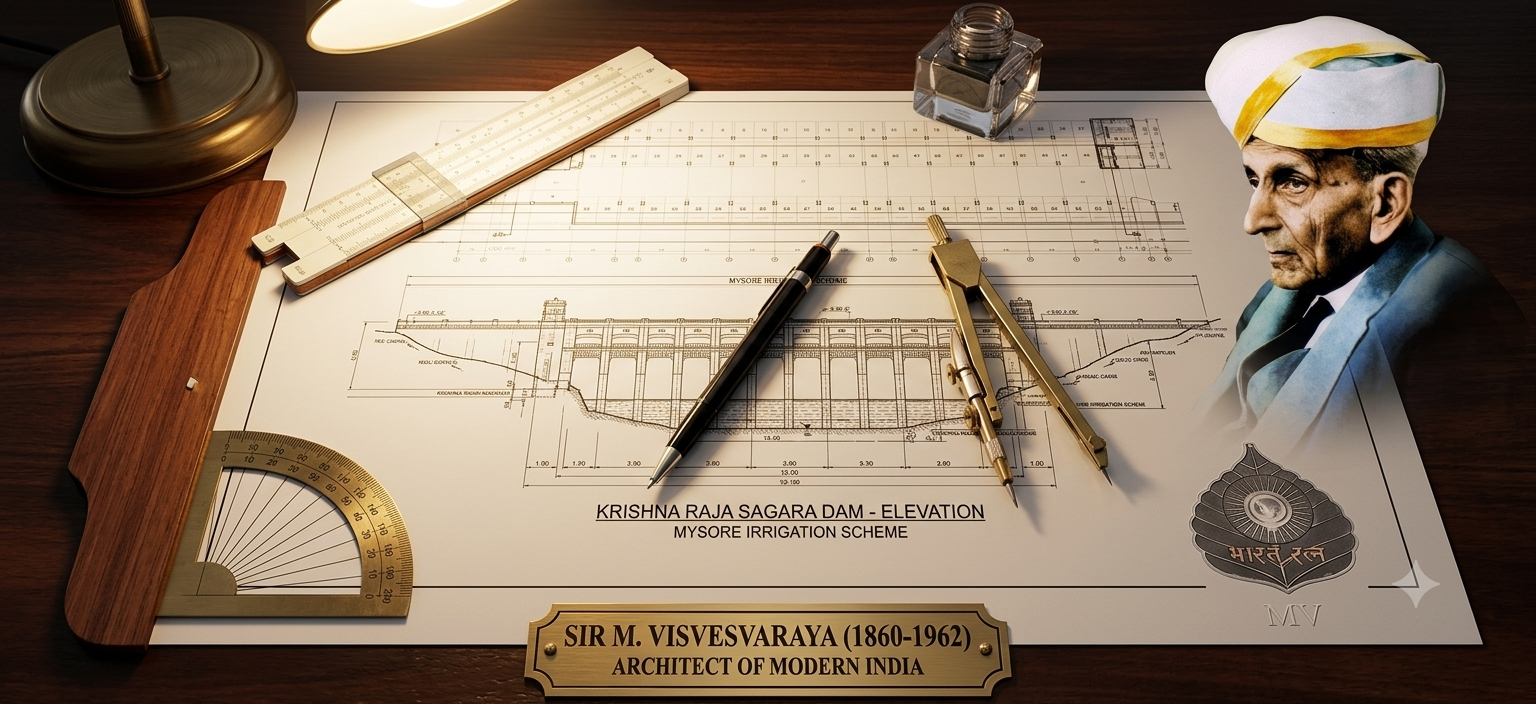
National Engineers’ Day: Remembering Bharat Ratna Sir Mokshagundam Visvesvaraya and India’s Engineering Legacy
Every year on September 15, India observes National Engineers’ Day in honour of the birth anniversary of Bharat Ratna Sir Mokshagundam Visvesvaraya, one of the country’s most celebrated engineers, administrators and nation-builders. The day is not merely an occasion to remember a remarkable individual; it is also an opportunity to recognise the contribution of engineers whose ideas, designs, calculations and innovations have played a decisive role in transforming India.
From bridges and dams to railways, industries, digital networks, renewable energy systems and advanced manufacturing, engineering has become deeply connected with almost every aspect of modern life. National Engineers’ Day therefore serves as a reminder that behind much of the physical and technological progress visible around us lies the work of engineers who convert scientific principles into practical solutions.
Sir M. Visvesvaraya’s life remains particularly significant because it demonstrated how technical knowledge could be combined with discipline, public service, administrative ability and a long-term vision for national development.
Born on September 15, 1861, at Muddenahalli in the erstwhile Kingdom of Mysore, Visvesvaraya went on to establish an extraordinary reputation as a civil engineer and statesman. His contribution to irrigation, water management, infrastructure and industrial development earned him widespread recognition during his lifetime and a lasting place in India’s history.
India honoured him with the Bharat Ratna in 1955, the country’s highest civilian award.
Today, engineers across the country work in fields that would have been difficult to imagine during Visvesvaraya’s era. Yet the fundamental principle remains unchanged: identify a problem, understand its scientific and technical dimensions, design a practical solution and use knowledge for the benefit of society.
The engineer who became a symbol of nation-building
The story of Visvesvaraya is closely linked with the development of modern engineering in India.
At a time when large-scale infrastructure development required enormous technical expertise, he emerged as an engineer known for precision, innovation and an extraordinary work ethic. His career included major responsibilities in water-resource management and public works.
He became particularly associated with irrigation and water-supply projects. His technical approach emphasised the importance of using water resources efficiently, designing reliable systems and planning infrastructure according to long-term requirements.
His reputation extended beyond individual engineering projects. Visvesvaraya believed that technological progress had to be supported by education, industrial development, efficient administration and disciplined planning.
That broader vision made him more than an engineer. He became a symbol of the idea that technical knowledge could contribute to the economic and social advancement of an entire region.
His career continues to be studied because it combined engineering expertise with public administration and institution-building.
Why September 15 is celebrated as National Engineers’ Day
September 15 was chosen to commemorate Visvesvaraya’s birth anniversary.
The occasion provides India with an annual opportunity to recognise engineers working across different sectors. It also encourages students and young professionals to understand the wider social responsibility attached to engineering.
Engineering is often associated with equations, drawings, machines, structures, software and technical specifications. But its influence extends much further.
When a safe bridge connects two communities, engineers have contributed.
When a water-treatment facility supplies clean water, engineering has played a role.
When electricity reaches remote areas, engineers have helped make that possible.
When a train operates efficiently, when a satellite communicates across vast distances, when a hospital uses sophisticated medical equipment or when a factory produces goods through automated systems, engineering knowledge stands behind the process.
National Engineers’ Day celebrates this often-unseen contribution.
From dams to digital systems
The engineering profession in India has changed dramatically since Visvesvaraya’s time.
In the early decades of modern Indian infrastructure development, civil, mechanical and electrical engineering were among the major areas of focus. Roads, irrigation systems, dams, railways, factories and power infrastructure required large numbers of technically trained professionals.
Today, the engineering landscape is far more diverse.
Computer science engineers develop software platforms and artificial intelligence systems. Electronics engineers work on semiconductor technologies and communication devices. Mechanical engineers contribute to robotics, automobile manufacturing and advanced production systems. Electrical engineers work on smart grids, renewable energy and electric mobility.
Civil engineers continue to design buildings, transport networks, water systems and resilient urban infrastructure.
Chemical engineers contribute to pharmaceuticals, materials, energy and industrial processes. Aerospace engineers work on aircraft and spacecraft. Environmental engineers focus on pollution control, waste management and sustainable development.
The profession has therefore expanded from the construction of physical infrastructure to the design of increasingly complex technological ecosystems.
Engineering and India’s infrastructure transformation
India’s economic growth is inseparable from its infrastructure.
Roads, railways, ports, airports, bridges, tunnels, power plants, irrigation networks and urban systems form the foundation upon which businesses and communities depend.
Engineering teams are responsible for converting ambitious plans into functioning infrastructure. That process involves surveying, mathematical modelling, structural calculations, material selection, environmental assessment, safety analysis, project management and quality control.
A successful infrastructure project is rarely the result of one person’s work. It generally requires cooperation between engineers from multiple disciplines, architects, planners, technicians, construction workers, administrators and local communities.
This collaborative nature of engineering reflects one of the most important lessons associated with Visvesvaraya’s career: technical excellence must be accompanied by organisation and effective implementation.
Water management: a continuing national priority
Visvesvaraya’s association with irrigation and water systems remains particularly relevant in contemporary India.
Water security is one of the major challenges facing rapidly developing societies. Population growth, urbanisation, agriculture, industrial demand and changing climatic conditions are placing increasing pressure on freshwater resources.
Engineers play a critical role in designing reservoirs, canals, pipelines, water-treatment plants, drainage systems and flood-control infrastructure.
Modern water engineering also increasingly involves data.
Sensors can monitor water levels. Digital systems can detect leaks. Geographic information systems can map water resources. Remote sensing can help assess changes in land and water bodies. Computational models can assist planners in understanding flood risks and water demand.
The technological tools have changed, but the objective remains remarkably similar to the challenge faced by earlier generations: use available resources intelligently and sustainably.
Engineers and the challenge of sustainable development
The engineering profession now faces a question that previous generations encountered on a smaller scale: how can development be achieved without placing unsustainable pressure on the environment?
Modern engineers are increasingly expected to consider energy efficiency, emissions, waste generation, biodiversity, resource consumption and lifecycle costs.
Green buildings, renewable-energy systems, electric vehicles, energy-efficient industrial equipment, water recycling and sustainable materials are examples of areas where engineering can directly influence environmental outcomes.
Solar and wind power require engineering solutions for generation, transmission, storage and integration into electricity networks.
Electric mobility requires advances in batteries, charging infrastructure, power electronics and vehicle design.
Waste management requires systems that combine mechanical processes, environmental science, logistics and data management.
The engineer of the 21st century is therefore not simply a builder of infrastructure but also a designer of sustainable systems.
The rise of artificial intelligence and advanced technology
One of the biggest changes in engineering has been the rapid development of digital technologies.
Artificial intelligence, machine learning, robotics, cloud computing, advanced sensors and automation are changing the way products and services are designed and delivered.
Engineers increasingly work with enormous quantities of data. Digital simulations can test designs before physical prototypes are manufactured. Artificial intelligence can assist in identifying patterns, predicting equipment failures and optimising industrial processes.
However, technological progress also creates new responsibilities.
Engineers designing AI-enabled systems must consider reliability, security, privacy, transparency and potential social consequences. Automation can improve productivity, but societies must also ensure that workers receive opportunities to acquire new skills.
The central challenge is therefore not whether technology should advance, but how it can advance responsibly.
Engineering education and the importance of practical skills
National Engineers’ Day also draws attention to engineering education.
A strong engineering education requires more than memorising formulas. Students need opportunities to experiment, build prototypes, analyse failures and solve real-world problems.
Laboratories, workshops, industrial training and project-based learning can bridge the gap between theoretical knowledge and practical application.
This is particularly important in a rapidly changing technological environment. Engineers entering the workforce today may encounter technologies that did not exist when they began their education.
Continuous learning has therefore become an essential professional habit.
The spirit of engineering education should encourage curiosity: Why did a system fail? Can a process be made more efficient? Can the cost be reduced without compromising safety? Can a product be redesigned to use fewer resources?
Such questions are the starting point of innovation.
The importance of vocational and technical education
India’s engineering ecosystem does not depend only on university-level engineers. Technicians, skilled workers and vocationally trained professionals form an equally important part of the technical workforce.
Industrial machines need to be installed, maintained and repaired. Electrical systems require skilled technicians. Refrigeration and air-conditioning equipment needs trained professionals. Manufacturing plants require people who understand tools, machinery, safety procedures and maintenance.
Technical education therefore plays an essential role in connecting young people with practical employment opportunities.
A healthy technical ecosystem requires cooperation among engineering colleges, industrial training institutes, polytechnics, universities, industries and research institutions.
Engineers design systems, while skilled technical professionals help operate, maintain and improve them. The success of modern infrastructure depends upon this entire chain.
Innovation begins with solving ordinary problems
Engineering innovation does not always require a spectacular invention.
Sometimes innovation means developing a low-cost irrigation mechanism for farmers.
Sometimes it means designing a safer road intersection.
Sometimes it means reducing electricity consumption in a factory.
Sometimes it means creating an affordable assistive device for a person with a disability.
Sometimes it means finding a way to purify water in a remote village.
The most meaningful engineering solutions are often those that respond to genuine needs.
This principle is particularly important for young engineers. Innovation should not be measured only by technological complexity. A simple solution that improves thousands of lives can be more valuable than an impressive invention with little practical impact.
Engineers in disaster management
India experiences floods, cyclones, earthquakes, landslides, heatwaves and other natural hazards. Engineers contribute significantly to disaster preparedness and recovery.
Structural engineers design buildings that can better withstand hazards. Civil engineers develop drainage and flood-management systems. Electrical engineers work to restore power after disasters. Communication engineers help maintain connectivity. Environmental engineers contribute to recovery and waste management.
Technology is also becoming increasingly important in early-warning systems.
Satellite data, weather forecasting, sensors, geographic mapping and computer models can help authorities assess risks and organise emergency responses.
The goal is gradually shifting from simply responding to disasters to building infrastructure that is more resilient before disasters occur.
Women engineers are changing the profession
Engineering was historically perceived in many societies as a predominantly male profession. That picture is changing.
Women engineers are increasingly contributing to civil engineering, electronics, computer science, aerospace, mechanical engineering, biotechnology, energy, research and other technical fields.
Their participation strengthens the profession by bringing a wider range of perspectives to problem-solving.
Encouraging girls to study science, technology, engineering and mathematics is therefore important for India’s future.
The engineering workforce of tomorrow must reflect the diversity of the society it serves.
The role of engineers in rural development
Engineering is not limited to major cities.
Rural India has enormous infrastructure and technological requirements. Roads, irrigation, drinking-water systems, agricultural machinery, renewable-energy solutions, cold-storage facilities, digital connectivity and rural healthcare infrastructure all require technical expertise.
Engineers can play an important role in designing solutions appropriate for local conditions.
For example, a technology that works effectively in a large industrial city may not be suitable for a remote village because of differences in cost, maintenance capacity, electricity availability or environmental conditions.
Good engineering therefore begins with understanding the user.
A successful solution is one that people can afford, operate, maintain and benefit from over the long term.
From local innovation to global ambition
India’s engineering community is increasingly participating in projects with global significance.
Indian engineers contribute to space exploration, advanced manufacturing, information technology, pharmaceuticals, telecommunications, renewable energy and large infrastructure programmes.
The country’s technology ecosystem has also produced a generation of entrepreneurs who combine engineering with business innovation.
Start-ups are developing solutions in areas such as agricultural technology, clean energy, electric mobility, financial technology, healthcare, education and logistics.
This growing innovation ecosystem demonstrates that engineering is no longer confined to traditional industries.
Ethics must remain at the heart of engineering
Technical ability without ethical responsibility can create serious consequences.
An engineer may design a structure that is mathematically sound, but if safety standards are ignored during construction, the final result can be dangerous.
A software system may be technically sophisticated, but if it mishandles sensitive information, it can harm users.
An industrial process may be profitable, but if it creates severe environmental damage, its social cost may outweigh its economic benefits.
Engineering decisions therefore carry responsibilities beyond technical performance.
Safety, honesty, sustainability, transparency and respect for human life must remain central to professional engineering.
This is one reason why the legacy of figures such as Visvesvaraya continues to matter. His reputation was built not simply on technical knowledge but also on discipline, public service and commitment to development.
The future engineer
The engineer of the future will likely need to combine several types of knowledge.
Technical expertise will remain essential, but engineers will also need communication skills, management ability, environmental awareness and an understanding of social needs.
Interdisciplinary work will become increasingly common.
A modern transportation project, for example, may involve civil engineering, electrical engineering, computer science, environmental studies, data analytics and urban planning.
Similarly, a smart agricultural system may require knowledge of mechanical design, electronics, sensors, software, data analysis and agricultural science.
The boundaries between traditional engineering disciplines are gradually becoming less rigid.
Visvesvaraya’s message for a new generation
More than six decades after his death, Visvesvaraya remains relevant because his life represents a combination of qualities that technology alone cannot provide.
Discipline.
Curiosity.
Professional excellence.
Long-term thinking.
Commitment to public welfare.
And the determination to convert knowledge into practical results.
These qualities are particularly important at a time when technological change is accelerating.
Young engineers have access to computing power, digital tools, laboratories and global knowledge on a scale that earlier generations could not have imagined. But access to technology does not automatically produce meaningful innovation.
The difference comes from how that knowledge is used.
Visvesvaraya’s legacy encourages young professionals to look beyond personal achievement and consider the larger purpose of their work.
National Engineers’ Day: more than a celebration
Across India, National Engineers’ Day is marked through educational programmes, seminars, technical exhibitions, competitions, workshops and institutional events.
Students present projects and prototypes. Engineers discuss emerging technologies. Institutions recognise professional achievements. Young learners are introduced to the possibilities offered by technical education.
Such activities can inspire students who are considering careers in science and engineering.
But the significance of the day can go further.
It can become an occasion to ask whether engineering education is adequately connected with real-world problems, whether innovation is reaching underserved communities, whether infrastructure is being designed for future climate conditions and whether technology is being used responsibly.
Remembering Visvesvaraya should therefore not be limited to recalling his biography.
His birth anniversary can also serve as a moment for India to examine the future of engineering itself.
Building an India prepared for tomorrow
India is entering an era in which engineering decisions will influence nearly every major development challenge.
Urbanisation will require better transport and housing systems.
Growing energy demand will require cleaner and more reliable power networks.
Climate pressures will require resilient infrastructure.
Digital expansion will require secure communication and computing systems.
Manufacturing growth will require automation, robotics and advanced production technologies.
Water scarcity will require efficient resource management.
Healthcare expansion will require new medical technologies and infrastructure.
Each challenge presents an engineering dimension.
The task is not merely to build more, but to build better.
Infrastructure must be safe. Technology must be accessible. Systems must be efficient. Development must be sustainable.
A tribute to the unseen workforce
On National Engineers’ Day, attention often turns to famous engineers and landmark projects. Yet millions of professionals whose names never appear in newspapers are also contributing every day.
A junior engineer checking a construction site.
A technician maintaining industrial equipment.
A design engineer working late to solve a manufacturing problem.
A software engineer debugging a critical system.
A civil engineer monitoring a bridge.
An electrical engineer maintaining a power network.
A mechanical engineer improving a machine.
A researcher developing a new material.
A student building a first prototype in a college laboratory.
Together, they form the technical workforce that supports modern society.
Their contribution may not always be visible, but its impact is everywhere.
Remembering a national icon
Sir Mokshagundam Visvesvaraya lived during a period when India’s modern industrial and infrastructural foundations were still developing. His work demonstrated what determined application of engineering knowledge could achieve.
His legacy survived because it was connected with tangible improvements in infrastructure, water management, administration and industrial development.
The Bharat Ratna awarded to him in 1955 formally recognised a lifetime of exceptional contribution. Yet perhaps the most enduring recognition comes every September 15, when generations of Indians remember his name while celebrating the engineering profession.
National Engineers’ Day thus connects history with the future.
It remembers an engineer from the 19th century while celebrating technologies that belong to the 21st century.
It honours dams and irrigation systems while looking toward artificial intelligence, renewable energy, robotics and space technology.
Most importantly, it celebrates the continuing human ability to solve problems through knowledge and innovation.
The road ahead
As India looks toward a more technologically advanced and sustainable future, the role of engineers will become even more important.
The country will need professionals capable of thinking creatively, working collaboratively and understanding the consequences of technical decisions.
Future engineering success will not be measured only by the size of a project or the sophistication of a machine. It will also be measured by whether technology improves lives, expands opportunity, protects resources and strengthens society.
That is the larger meaning behind National Engineers’ Day.
September 15 is a tribute to Visvesvaraya, but it is also a tribute to an idea: engineering is ultimately about turning knowledge into solutions.
From the water systems and infrastructure associated with Visvesvaraya’s era to today’s digital, industrial and sustainable technologies, India’s engineering journey reflects a continuing pursuit of progress.
On his birth anniversary, the nation remembers a legendary engineer whose life combined technical excellence with public service.
And as a new generation of engineers prepares to confront challenges that are more complex than ever, his legacy offers a simple but powerful lesson: great engineering is not only about building remarkable things; it is about building a better future for people.
A legacy that continues to inspire
National Engineers’ Day is therefore not simply a date on the calendar. It is a national acknowledgement of the people who design, construct, operate, maintain and improve the systems on which modern life depends.
The celebration of Sir M. Visvesvaraya’s birth anniversary provides an opportunity to honour that contribution and encourage young minds to enter the world of science, technology and innovation.
India’s future will require imagination, precision, courage and responsibility.
Engineers will be at the centre of that journey.
And every September 15, as the nation remembers Bharat Ratna Sir Mokshagundam Visvesvaraya, it also celebrates the countless engineers who continue to transform ideas into reality—one design, one machine, one structure, one system and one solution at a time.
Read More: NEET: From a Hillside Classroom to a Medical Dream, Two Sisters’ Remarkable Success!!!