

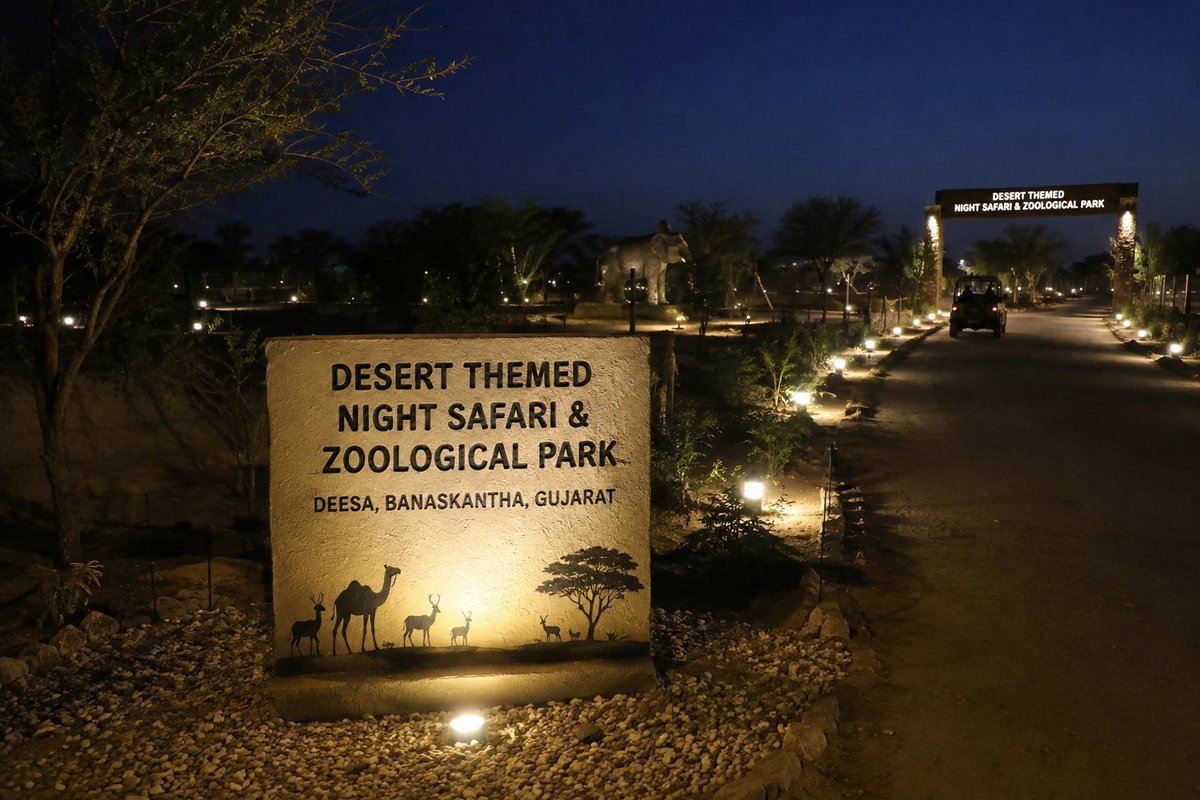
Asia’s First Desert-Themed Night Safari Zoo Coming Up in India: A Paradigm Shift in Wildlife Tourism
For over a century, the global concept of a zoological garden has been intrinsically tied to daylight excursions—families walking past glass barriers and fenced enclosures under the midday sun to catch glimpses of animals, many of which spend peak hours sleeping in shaded corners. India is now set to break this traditional mold by establishing Asia’s very first Desert-Themed Zoological Park featuring an integrated Night Safari.
Located in the Juna Deesa region of Gujarat’s Banaskantha district, this monumental eco-tourism facility spans across 103 hectares (approx. 254 acres) along the Banas River basin. Sanctioned by the Central Zoo Authority (CZA) and developed by the Gujarat Forest Department with an estimated budget of ₹542.14 crore (~$65 Million USD), the project represents a transformative leap in wildlife conservation, nocturnal behavioral studies, and sustainable tourism.
1. Strategic Location & Ecological Context: Why Juna Deesa?
The choice of Juna Deesa in North Gujarat was guided by unique geographical, climatic, and ecological attributes:
-
Arid Topography: The region surrounding the Banas River basin naturally features semi-arid soil, natural sand dunes, and desert-adapted flora (cacti, acacia, and thorny shrubs).
-
Ideal Climate for Arid Fauna: The local microclimate closely mirrors the natural habitats of desert species native to the Thar Desert, the Rann of Kutch, and similar semi-arid zones in Africa and Australia.
-
Connectivity & Tourism Circuit: Situated strategically near major travel nodes, Juna Deesa will form a core leg of North Gujarat’s emerging tourism corridor—integrating seamlessly with the Ambaji Pilgrimage Circuit and the Nadabet Indo-Pak Border Tourism Circuit.
2. Dual-Mode Operations: Daytime Zoo + Thrilling Night Safari
The defining highlight of the park is its dual-purpose operational design, providing two completely distinct visitor experiences within a single world-class facility:
-
Daytime Educational Zoological Park:
During daylight hours, the park functions as a traditional, state-of-the-art zoological garden. Visitors can explore sprawling open-air enclosures on foot or via quiet, zero-emission electric golf carts.
-
Drive-Through Night Safari (5 Dedicated Nocturnal Enclosures):
As night falls, five specially designed nocturnal enclosures open for guided night safaris.
-
Moonlight Effect Lighting: To ensure animals remain undisturbed, soft LED systems mimicking natural moonlight are deployed. These provide sufficient visibility for guests while allowing animals to move comfortably.
-
Observing True Nocturnal Behavior: Desert fauna are evolutionary adapted to avoid harsh daytime temperatures, becoming active primarily after dusk. The night safari offers visitors an unprecedented window into the natural hunting, territorial, and social behaviors of nocturnal species.
-
3. Operational Comparison: Daytime Zoo vs. Night Safari
| Feature / Metric | Daytime Zoological Park | Drive-Through Night Safari |
| Operating Hours | 09:00 AM – 05:00 PM | 06:30 PM – 11:00 PM |
| Transport Mode | Pedestrian walkways, Electric Golf Carts | Enclosed glass-window electric safari buses |
| Primary Focus | Diurnal animals, aviary, reptiles, botanical gardens | Nocturnal predators & desert fauna across 5 enclosures |
| Lighting System | Natural Sunlight | Controlled Soft Moonlight LED Systems |
| Visitor Experience | Educational, family leisure, photo opportunities | Thrilling wildlife observation, nocturnal research |
4. Rich Biodiversity: Native & Exotic Species
The facility is planned to house approx. 2,700 animals across 83 distinct species, balancing native Indian fauna with exotic animals from arid regions globally:
Native Arid & Semi-Arid Species
-
Mammals: Chinkara (Indian Gazelle), Blackbuck, Indian Wild Ass (Khur), Caracal, Desert Fox, Indian Wolf, Striped Hyena, Asiatic Lion, and Indian Leopard.
-
Reptiles & Avian: Desert Monitor Lizard, Spiny-tailed Lizard, Great Indian Bustard (conservation focus), sand boas, and various desert raptors.
Exotic International Species
-
African Desert Fauna: Black Rhinoceros, African Cheetah, Giraffe, Scimitar-horned Oryx, Grevy’s Zebra, Chimpanzee, and Meerkat.
-
Australian & Global Fauna: Red Kangaroo, Wallaby, Ostrich, and Emu.
5. Infrastructure, Capital Outlay, & Economic Impact
Supported by a ₹542.14 crore state allocation, the park incorporates cutting-edge conservation and visitor infrastructure:
-
Super-Specialty Veterinary Hospital: Equipped with digital X-ray, portable ultrasound, ICU beds, pathology labs, and animal surgical suites.
-
Captive Breeding & Research Center: Dedicated facilities focused on breeding critically endangered desert species like the Caracal and Great Indian Bustard.
-
Green Infrastructure: Solar power generation, rainwater harvesting, and zero-liquid discharge sewage treatment plants (STP).
-
Economic Growth: The project is projected to generate thousands of direct and indirect jobs across hospitality, transport, wildlife guiding, and regional handicrafts.
By harmonizing a desert theme, daytime zoological displays, and an unprecedented night safari experience, Gujarat’s new facility at Juna Deesa stands poised to redefine wildlife tourism in Asia. It offers a perfect balance of public entertainment, economic revitalization, and high-impact ecological conservation.
Read More: Beyond Chemistry: The Science, History, and Healing Power of Smell!!!