

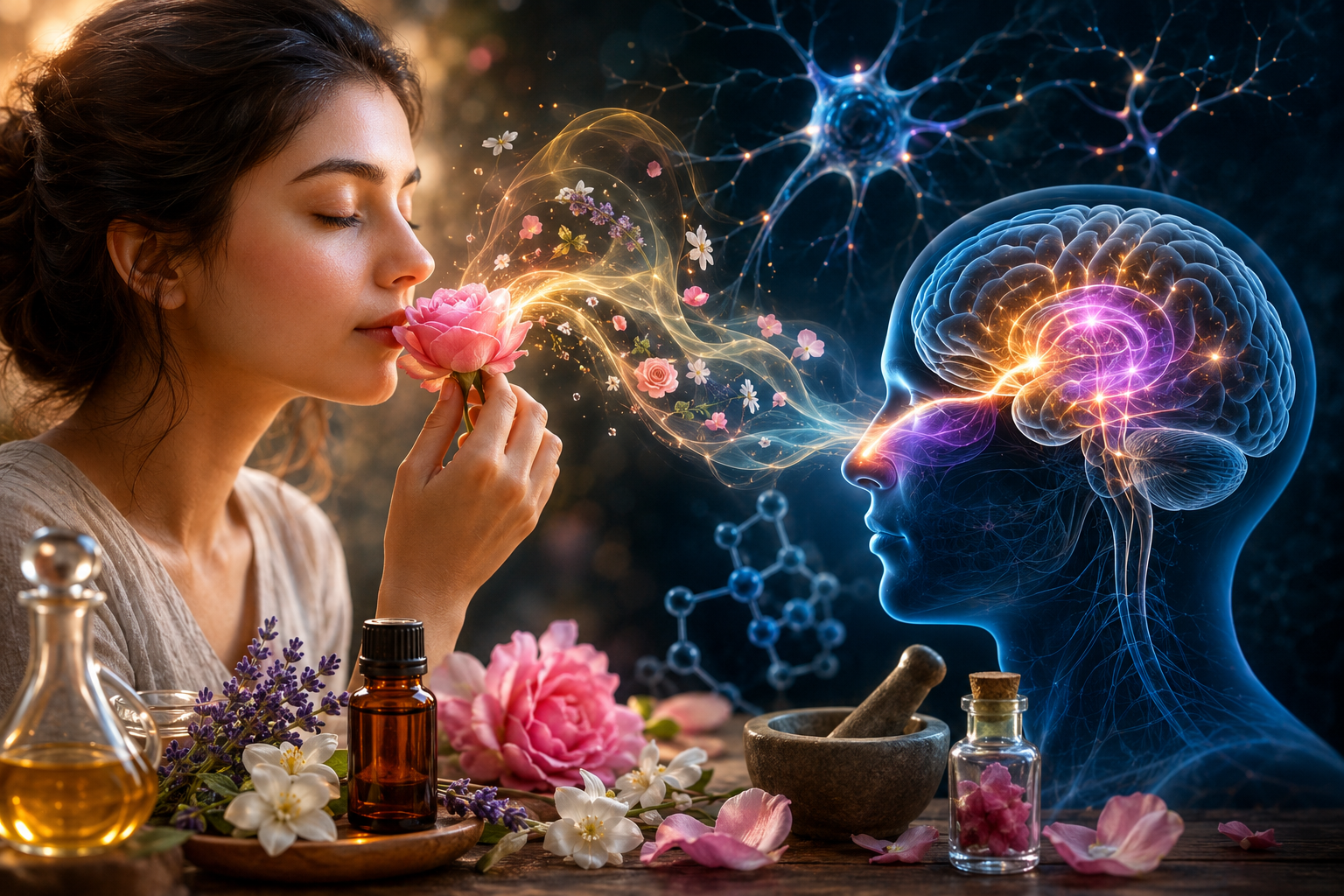
Beyond Chemistry: The Science, History, and Healing Power of Smell
Where does smell truly reside? Is it merely a biochemical transaction of volatile molecules engaging olfactory receptors, or does it belong to the intimate labyrinths of human emotion and memory?
The faint, vanilla-tinged musk of an old book can instantly halt time, transporting us to a forgotten childhood library. The bitter, rich aroma of freshly brewed coffee can sketch the vivid landscape of a lazy Sunday morning. To experience a sudden, overwhelming flood of nostalgic memories upon catching a passing scent is neither pure imagination nor poetic exaggeration; modern cognitive neuroscience confirms that smell possesses a unique, unmediated doorway to the human subconscious.
Smell is often treated as the silent, invisible sibling among our senses. We consciously celebrate sight, sound, touch, and taste, yet smell moves quietly in the background. However, from the romantic verses of poets to the rigorous frameworks of ancient philosophy and modern neurobiology, the profound importance of olfactory perception is finally stepping into the spotlight. Across the globe, researchers and medical professionals are tapping into this sensory pathway to revitalize the brain—a clinical practice known today as Smell Training or Olfactory Training.
The Philosophy and Poetics of Odor
Long before neuroimagers mapped the olfactory cortex, literature and philosophy recognized the singular power of scent.
In ancient Indian philosophy, particularly within the Samkhya school, the material world is understood through five core elemental properties (Tanmatras): sound, touch, form, taste, and smell. The classical text declares:
“Shabda-sparsha-rupa-rasa-gandhanam prithivi gandhavati”
(Among sound, touch, form, taste, and smell—smell is the intrinsic, definitive quality of the Earth.)
Ancient thinkers posited that while other elements share overlapping sensory characteristics, smell represents the grounding essence of physical reality. Without smell, human perception loses its emotional depth and vibrancy.
This philosophical truth found its artistic counterpart in modern poetry. Bengali poet Jibanananda Das captured the intoxicating, almost tactile nature of scent when he wrote:
“Grass green as young pomelo—a fragrance just like that…”
For the poet, the scent of grass was not merely an environmental observation; it was an emulsion so rich he felt compelled to drink it like green wine from a glass.
Similarly, the humorist Sukumar Ray touched upon the analytical side of smell in his satirical poem Gandhabichar (“The Judgment of Smell”). In the poem, an elderly court official (Nazir) inspects the minister’s clothes by pressing his nose against the fabric to render a precise judgment on its odor. Beneath the humor lies an astute observation: smelling is not merely a passive physical reaction; it requires attention, discrimination, and cognitive processing.
The Neurological Architecture: How the Brain Processes Smell
To understand why scent exerts such an extraordinary hold over our minds, we must look at the unique neural wiring of the human olfactory system (olfaction).
The Physical Pathway
When we inhale, airborne chemical molecules—often lightweight protein structures or volatile organic compounds—enter the nasal cavity. Deep inside the upper nasal passage, directly beneath the base of the brain, lies a specialized tissue called the olfactory epithelium.
-
Receptor Activation: The olfactory epithelium contains roughly 4 million to 10 million specialized olfactory sensory neurons.
-
Signal Transduction: These neurons capture the incoming chemical molecules and convert their chemical signatures into electrical impulses.
-
Bulb Consolidation: The electrical signals travel upward through tiny perforations in the bone to the olfactory bulb, situated at the base of the frontal lobe, where the information is filtered, organized, and refined.
-
Cortical Delivery: From the bulb, the signals are dispatched to the olfactory cortex (or orbitofrontal cortex) for conscious identification.
The Shortcut to Emotion: Bypassing the Thalamus
What makes the sense of smell neurologically unique compared to sight, hearing, touch, or taste?
For the other four senses, incoming sensory data must first pass through a central routing hub in the brain called the thalamus. The thalamus acts as a gatekeeper, filtering and relaying sensory information before sending it to higher cortical areas for processing.
The olfactory system bypasses this gatekeeper.
Olfactory signals travel directly from the olfactory bulb into the brain’s limbic system—the ancient evolutionary core responsible for emotion, instinct, and long-term memory formation. Within the limbic system, scent data interacts immediately with two critical structures:
-
The Amygdala: The brain’s emotional center, governing fear, pleasure, love, anxiety, and distress. Bad or pungent odors immediately trigger defense or disgust mechanisms, raising stress levels, whereas sweet, soothing scents stimulate the release of neurotransmitters like serotonin and dopamine, promoting calm and mitigating depressive moods.
-
The Hippocampus: The seat of memory storage and retrieval.
This direct neural link explains why a scent can trigger an intense emotional reaction or bring back a vivid memory long before we have consciously identified what the smell actually is.
Memory, Appetite, and the “Proust Effect”
The profound relationship between smell, memory, and behavior manifests in several key psychological phenomena.
The Proustian Memory Phenomenon
In his monumental novel In Search of Lost Time (or Remembrance of Things Past), French author Marcel Proust described a scene where the narrator dips a madeleine cake into a cup of tea. The taste and aroma instantly trigger an overwhelming wave of childhood memories from the fictional town of Combray—memories that had been completely hidden from his conscious mind for decades.
Psychologists and neuroscientists now refer to this as the Proust Effect (or Proustian Memory Phenomenon). It describes how sensory cues—especially smell and taste—can involuntarily recall vivid, emotionally charged episodic memories from early life. Because olfactory memory is stored within the limbic structure, these memory traces are exceptionally durable over time.
Appetite and Mood Modulation
The impact of smell extends to basic survival instincts. Research demonstrates that the hypothalamus—the brain structure governing hunger, thirst, and body temperature—is directly stimulated by scent cues.
The ancient adage “Ghramena ardhabhojanam” (“Inhaling the aroma of food is equivalent to half a meal”) reflects a genuine physiological reality. The rich aroma of a cooking meal triggers preliminary digestive responses, modulates appetite, and generates a sense of satiety. Conversely, pleasant scents stimulate neurochemical pathways that lower cortisol (the primary stress hormone), reduce anxiety, and stabilize mood.
The Pandemic Pivot: Anosmia, Hyposmia, and Medical Awareness
While smell has always been vital, its clinical significance skyrocketed during the COVID-19 pandemic. Millions of people worldwide suddenly experienced a total or partial loss of their olfactory sense.
Key Medical Terminology
| Term | Medical Definition | Clinical Impact |
| Anosmia | Complete loss of the sense of smell | Total inability to perceive odors; severe reduction in flavor perception and emotional connectivity |
| Hyposmia | Partial loss or diminished sensitivity of smell | Decreased ability to detect subtle scents or safety hazards (e.g., gas leaks, smoke) |
| Parosmia | Distortion of normal smell perception | Pleasant scents are perceived as foul, burnt, or chemical odors |
| Phantosmia | Olfactory hallucinations | Perceiving smells that are not present in the environment |
For many who lost their sense of smell during the pandemic, the experience was disorienting. Patients reported a sense of emotional detachment, a loss of appetite (since flavor is heavily dependent on olfactory input), and a heightened incidence of depressive symptoms.
This global surge in olfactory dysfunction accelerated scientific interest in therapeutic interventions, putting Smell Training at the forefront of post-viral rehabilitation and neuro-otolaryngology.
What is Smell Training? The Protocol and Mechanism
Smell training is a structured, non-invasive physical therapy for the olfactory nervous system. Just as physical therapy helps rebuild muscle strength after an injury, olfactory training stimulates and rewires damaged neural pathways between the nose and the brain.
The Classical Protocol
Pioneered clinically by Dr. Thomas Hummel and his research team at the University of Dresden in 2009, standard smell training involves systematically exposing the nasal passages to four distinct odor categories:
-
Floral: Rose
-
Fruity/Citrus: Lemon
-
Resinous/Cooling: Eucalyptus
-
Spicy: Clove
Step-by-Step Training Methodology
The Mechanism: Neuroplasticity and Neuro-regeneration
Why does this simple exercise work?
According to head and neck specialists, repeated, structured exposure to specific odorants stimulates the damaged olfactory sensory neurons and their supporting cells. This process leverages two fundamental properties of the nervous system:
-
Neurogenesis: Olfactory sensory neurons are among the few nerve cells in the human body capable of regenerating throughout adult life.
-
Neuroplasticity: The brain’s ability to reorganize itself by forming new neural connections in response to learning, experience, or recovery from injury.
By combining physical inhalation with active mental visualization, smell training engages both peripheral nasal receptors and central cognitive networks, encouraging the brain to repair and recalibrate its olfactory processing pathways.
Historical Antecedents: From Ancient Nasya to Modern Neuro-Imaging
While modern clinical trials have formalized “olfactory training,” using smell as a therapeutic tool is an ancient practice.
Traditional Eastern Medicine
In classical Ayurvedic texts such as the Charaka Samhita and Susruta Samhita, olfactory interventions form a core component of preventive and curative health.
-
Nasya Therapy: As part of the Panchakarma detoxification framework, medicated oils, herbal extracts, or ghee were administered through the nasal passages to stimulate cranial nerves, clear sinus congestion, and treat disorders affecting the head and neck.
-
Aromatics for Cognitive Function: Medicated inhalations were prescribed to enhance memory, sharpen focus, and treat conditions resembling modern tension headaches, anxiety, and cognitive decline.
Global Contemporary Research
Today, leading research centers are expanding olfactory therapy well beyond post-viral recovery:
-
University of East Anglia (UK): Investigating the role of olfactory deficits as early diagnostic indicators for neurodegenerative conditions like Parkinson’s disease and Alzheimer’s disease.
-
Stockholm University (Sweden): Studying how olfactory stimulation impacts the hippocampus in aging adults to build cognitive reserve and mitigate age-related memory loss.
-
Harvard University (USA): Pairing olfactory training with functional Magnetic Resonance Imaging (fMRI) to monitor real-time changes in brain volume—specifically analyzing how smell training influences structural changes in cortical grey matter.
Clinical Reality: Indications, Nuances, and Medical Consensus
Despite promising research, the medical community emphasizes that smell training is a targeted therapeutic tool rather than a universal cure-all.
Where Smell Training is Effective
-
Post-Viral Olfactory Loss: Most effective when loss is due to viral damage to the supporting cells of the olfactory epithelium.
-
Age-Related Decline: Helpful in stimulating sluggish neural pathways in elderly individuals.
-
Early Neurodegenerative Support: Used as an adjunct therapy to maintain cognitive engagement.
Limitations and Contraindications
Medical specialists, including ENT surgeons and neuro-otolaryngologists, point out several critical caveats:
-
Structural Obstructions: If olfactory loss is caused by physical blockages—such as large nasal polyps, severe septum deviation, or chronic sinus inflammation—smell training cannot restore airflow to the receptors. Surgical or pharmacological intervention (e.g., corticosteroids) is required first.
-
Nerve Transection: If severe head trauma or skull fractures have completely severed the olfactory nerve fibers passing through the cribriform plate, peripheral smell training will not restore function.
-
Qualitative Distortions and Psychiatric Conditions: Patients suffering from severe parosmia or olfactory hallucinations require individualized medical evaluations rather than standard sensory training alone.
As clinical trials continue, smell training remains a low-risk, highly promising intervention—a bridge connecting ancient sensory wisdom with the cutting edge of cognitive neuroscience.
Conclusion: Reclaiming the Olfactory World
Smell is far more than a biological mechanism for detecting environmental hazards or enjoying food; it is an irreplaceable thread woven into the fabric of human emotion, memory, and cognitive health. Whether through the timeless imagery of poetry, the ancient principles of holistic medicine, or the precision of modern neuro-imaging, we are discovering that nurturing our olfactory sense is vital to keeping our minds vibrant and connected to the world around us.
As scientific trials progress, smell training stands as a testament to the brain’s remarkable capacity for renewal—proving that by pausing to consciously inhale and reflect on the subtle scents around us, we can awaken our minds and rediscover the rich, scented landscape of our lives.
Read More: Dahi Beyond the Bowl: How the Ancient Superfood Dahi Is Revolutionizing Modern Probiotic Science!!!