

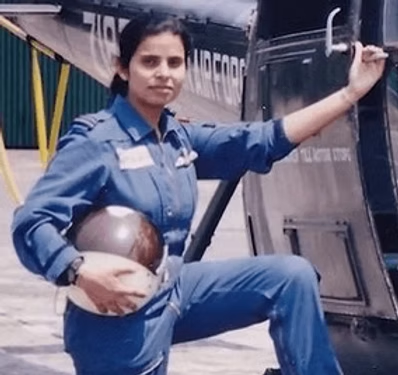
The Kargil Girl: How Flight Lieutenant Gunjan Saxena Rewrote Indian Aviation History in the High-Altitude Battlefields of 1999
During the summer of 1999, the jagged peaks of the Kargil sector in Jammu and Kashmir transformed into a perilous theater of war. Under Operation Vijay, the Indian Armed Forces launched a relentless, high-altitude counter-offensive to reclaim strategic mountain heights occupied by Pakistani regular soldiers and state-backed infiltrators. Year after year, as the nation observes Kargil Vijay Diwas to honor the supreme sacrifices of soldier-citizens, the popular memory naturally conjures images of infantrymen scaling icy cliffs under heavy artillery fire.
Yet, tucked within the saga of this triumph lies an unprecedented chapter of Indian military aviation—one that defied deep-seated societal conventions and proved that valor carries no gender.
In April 1999, just weeks before full-scale combat erupted, a 24-year-old Flight Lieutenant stood in the station commander’s office at the Udhampur Air Force Station. The forward base commander looked at the young officer and posed a direct, unsettling question: “Do you have any objection to flying directly into the operational warzone?”
Without a moment’s hesitation, the young aviator replied: “There is no question of any objection, sir. In fact, I am deeply honored to receive this opportunity!”
The commander pressed further, testing her resolve: “And what if you are shot down and captured behind enemy lines?”
Reaching instinctively toward her sidearm, she answered with calm composure: “I have an automatic pistol with me, sir. I will handle it. And if the situation demands, please issue me an assault rifle as well.”
That officer was Flight Lieutenant Gunjan Saxena. Alongside her colleague, Flight Lieutenant Sreevidya Rajan, she was about to make history as one of the first female combat aviators in the Indian Air Force (IAF) to fly active missions in an open warzone.
Roots of Valor: From Lucknow to the Cockpit
Born in 1975 in Lucknow, Uttar Pradesh, Gunjan Saxena grew up immersed in the traditions of military discipline and public service. Her father served as a Lieutenant Colonel in the Indian Army, while her brother followed in those footsteps to wear the olive green uniform. Surrounded by talk of strategy, honor, and duty, the idea of serving the nation was second nature to her.
Her family affectionately nicknamed her Gunjan—meaning a soft humming sound—because of her chatty, inquisitive nature as a child. Her destiny took a definitive turn at the age of five during a visit with a relative who was a commercial pilot. For the first time, she stepped inside a flight cockpit. The dials, switches, and panoramic view of the runway ignited a passion that never faded.
Educational Journey and Joining the Air Force
Gunjan pursued her higher education at Delhi University’s prestigious Hansraj College, earning a Bachelor of Science (B.Sc.) degree in Physics. Driven by her dream of flying, she simultaneously enrolled at the Safdarjung Flying Club in New Delhi to gain foundational civil aviation training.
In 1994, the Indian Air Force took a historic step by opening its doors to women pilots under the Short Service Commission (SSC) scheme. Gunjan appeared for the rigorous Services Selection Board (SSB) examination and cleared every phase with flying colors. Out of thousands of applicants across the country, she earned a spot among the elite group of 25 women officer cadets who formed the IAF’s pioneering batch of female helicopter pilots.
Following her training at the Air Force Academy, her initial operational posting brought her to the Udhampur Air Base in Jammu and Kashmir—a strategic hub tasked with maintaining air support across the volatile northern borders.
Into the Line of Fire: The Kargil War of 1999
Five years into her service, the Kargil conflict erupted. Enemy forces had secretly seized high-altitude posts across the Line of Control (LoC) in Dras, Batalik, Kaskar, and Tololing. The Indian Air Force launched Operation Safed Sagar to support ground troops by conducting strike missions, reconnaissance, and crucial air-logistics support in some of the most unforgiving terrain in the world.
Flight Lieutenant Gunjan Saxena and Flight Lieutenant Sreevidya Rajan were ordered to fly light utility helicopters directly into the theater of operations.
The Unarmed ‘Cheetah’ in Missile-Ridden Skies
The aircraft assigned to Gunjan was the HAL Cheetah—a lightweight, single-engine utility helicopter known for its high-altitude capabilities. However, the ‘Cheetah’ was entirely unarmored:
-
No Armor Plating: The cockpit offered virtually no structural protection against ground fire or shrapnel.
-
No Defensive Weaponry: Unlike dedicated attack helicopters, her chopper carried no mounted machine guns, flare dispensers, or rocket pods.
-
Unforgiving Terrain: Flying through narrow mountain passes at altitudes exceeding 13,000 to 18,000 feet required precise pilot skills, as the thin air drastically reduced engine power and rotor lift.
Despite these immense hazards, Gunjan took to the skies over Dras, Tololing, and Batalik day after day. Enemy troops positioned on high ridges regularly targeted flying assets with small-arms fire and shoulder-fired surface-to-air missiles (SAMs).
On two separate occasions, Pakistani anti-aircraft missiles passed within razor-thin distances of her helicopter. Maintaining her composure under fire, she executed evasive maneuvers and managed to safely recover her aircraft, completing vital medical evacuation (Medevac) missions and retrieving wounded soldiers from isolated forward posts.
Comparative Overview: War Operations & Fleet Dynamics
To better understand the operational context of Gunjan Saxena’s missions during the 1999 conflict, the table below outlines key parameters of her deployment:
| Operational Parameter | Strategic Details & Context |
| Theater of War | Kargil, Dras, Batalik, and Tololing Sectors (J&K) |
| IAF Air Base | Udhampur Air Force Station (Forward Post Deployment) |
| Aircraft Operated | HAL ‘Cheetah’ (Unarmed Utility Helicopter) |
| Mission Mandates | Casualty Evacuation, Supply Drops, Reconnaissance, Mortuary Retrieval |
| Threat Environment | High-Altitude Airspace, SAMs, Small Arms & Artillery Fire |
| Commission Type | Short Service Commission (7-Year Tenure) |
| Service Period | 1994 – 2004 |
Breaking Barriers: Overcoming Institutional & Infrastructure Challenges
Operating as a female aviator in the late 1990s presented challenges beyond the tactical dangers of the warzone. The infrastructure at forward operating bases had been designed entirely for male personnel. Dedicated changing rooms, separate rest quarters, or basic, suitable washroom facilities for women were non-existent at many austere forward locations.
Rather than letting these conditions hinder her focus, Gunjan and her female colleagues adapted quickly. They focused entirely on mission readiness, proving their competence side by side with their male counterparts.
“When you enter the cockpit, the aircraft does not know whether the pilot is a man or a woman,” Saxena noted in subsequent reflective interviews. “The controls respond purely to skill, discipline, and training.”
At the time, terms of service restricted female officers to Short Service Commissions of seven years (later extended in subsequent policy revisions). Consequently, after seven years of flying service, Flight Lieutenant Gunjan Saxena concluded her active military aviation career in 2004.
The Legacy: Paving the Way for Permanent Commissions and Fighter Pilots
The courage displayed by Gunjan Saxena and Sreevidya Rajan during Operation Vijay marked a major turning point for the Indian Armed Forces. Their successful high-altitude wartime operations helped dismantle long-standing doubts regarding women’s capability to operate in active combat environments.
Over the next decade and a half, policy reforms reshaped the military landscape:
-
Permanent Commissioning: The Indian judiciary and Ministry of Defence expanded options for female officers to secure Permanent Commissions, enabling lifelong military careers.
-
Induction into Fighter Streams (2016): In a historic policy shift, the Indian Air Force formally opened the combat fighter stream to women.
-
The Next Generation: Flying Officers Avani Chaturvedi, Bhawana Kanth, and Mohana Singh became the first female fighter pilots inducted into combat squadrons, taking command of supersonic aircraft like the MiG-21 Bison.
Life Beyond the Sky and Historical Recognition
Following her military service, Gunjan Saxena transitioned to civilian life. She married a fellow Indian Air Force helicopter pilot, and the couple settled in Jamnagar, Gujarat, raising their daughter.
For her courage and service during the Kargil War, she received civilian honors—including the Shaurya Veer award presented by a civic organization in Uttar Pradesh—and remains widely recognized across India as an inspiring figure in modern military history.
Her journey inspired the 2020 feature film Gunjan Saxena: The Kargil Girl. While cinematic retellings introduced creative adaptations for dramatic effect, Saxena reaffirmed that her actual military journey was grounded in the professionalism and camaraderie of the Indian Air Force.
Conclusion: An Enduring Symbol of Indomitable Will
The story of Flight Lieutenant Gunjan Saxena is far more than an individual military biography; it stands as a landmark moment in India’s journey toward gender equality in national defense.
When duty called in the summer of 1999, she flew unarmed into combat skies, risking her life to rescue wounded soldiers and keep vital supply lines open. Her legacy lives on every time a young girl looks up at the sky and dares to dream of taking the controls of an IAF aircraft. She demonstrated that courage knows no gender, leaving an indelible mark on the history of Indian aviation.
Read More: Health Tips: Stay Healthy This Monsoon-Expert Medical Guidelines for Preventing Seasonal Illnesses